
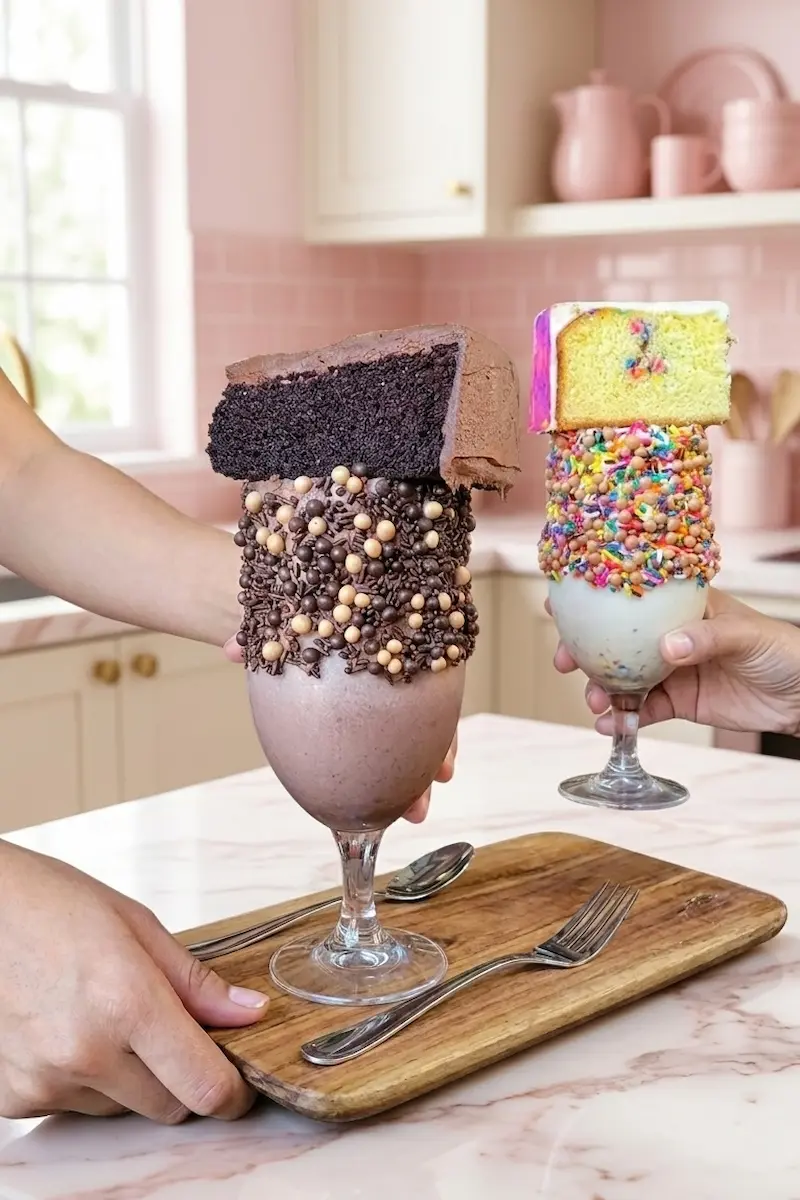
A cake shaker is exactly what the name promises: a full cake experience, in a jar, that you shake before you eat. Cake layers, frosting, mix-ins, and toppings assembled in a wide-mouth mason jar and sealed until serving. The shaking mixes the layers together into a chaotic, creamy, intensely satisfying dessert that requires no plates, no cutting, and no serving utensils beyond the spoon in your hand.
The format became popular for all the right reasons. It solves the birthday cake problem for parties where cutting and plating is logistically annoying. It turns a homemade cake into a portable gift that travels beautifully. It gives each guest their own individual dessert with zero cross-contamination and perfect portion control. And it looks extraordinarily good in a clear jar, with visible alternating layers of cake and frosting, before the shaking begins.
This guide covers everything: the anatomy of a cake shaker, a complete recipe for the classic vanilla version with detailed frosting and layering instructions, six flavor variations from funfetti to matcha, make-ahead and storage guidance, gifting ideas, and the common mistakes that lead to soggy cake or a leaking jar. The assembly takes 30 minutes once the cake is baked. The baking itself is a standard 25-minute cake recipe. The result is a genuinely impressive, genuinely portable dessert that costs about $2.50 per serving.
Table of Contents
Quick Answer: The Perfect Cake Shaker
🎂 At a Glance: Cake Shaker
What Is a Cake Shaker? The Trendy Portable Dessert
The Concept Behind Cake Shakers
A cake shaker is a layered dessert assembled in a clear, sealable jar. The layers are simple: cake cubes or crumbles alternate with frosting and any additional mix-ins you choose. The jar is sealed with a lid, which serves two purposes: it keeps the contents fresh during transport, and it allows the eponymous shaking motion that mixes the layers just before eating. That shaking is what transforms a neat layered jar into a creamy, thoroughly combined dessert where every spoonful contains cake, frosting, and filling in roughly equal proportion.
The concept is not new. Mason jar cakes and “cake in a jar” recipes have appeared in home baking circles for well over a decade. What changed in the mid-2020s was the specific framing of the shaking instruction as a feature and the widespread adoption of the clear wide-mouth jar format that shows the layers so clearly before mixing. The combination of visual drama (the layers before shaking) and kinetic engagement (the shaking itself) made the format particularly well-suited to social media documentation.
Why Cake Shakers Are So Popular
Several practical advantages converge in the cake shaker format that explain its staying power beyond the initial trend:
Individual portions without the math. A standard cake requires calculating serving sizes, cutting cleanly, and plating. A cake shaker is one jar, one person, one serving. The portion is defined by the jar size before assembly begins.
Make-ahead reliability. Assembled cake shakers sealed in jars can be refrigerated for 3 to 4 days without quality loss. The cake actually improves slightly over the first 24 hours as the frosting softens the cake layers. This makes cake shakers one of the most practical batch-bake party desserts available.
Travel-friendliness. A sealed mason jar is significantly more portable than any plate-served dessert. It fits in a cooler, a bag, or a cup holder. It does not slide, does not require support at an angle, and does not leak unless the lid is improperly sealed.
Visual appeal out of proportion to effort. The clear jar, the visible alternating layers, and the lid-on presentation look professional and deliberate. Most guests do not immediately recognize this as a format that requires no more skill than a standard layered cake.
Best Occasions for Cake Shakers
- Birthday parties: Individual jars eliminate the “who gets the corner piece” debate entirely. Label each jar with the recipient’s name for a personalized touch.
- Baby showers and bridal showers: Pastel-colored frostings and themed sprinkles make individually labeled cake shakers a gift and a dessert simultaneously.
- Potlucks and picnics: The travel format is ideal. No serving implements needed on-site; each guest arrives with their own jar.
- Teacher gifts and thank-you presents: A decorated jar with a custom label is a more personal and memorable gift than a box of chocolates, at a lower cost per unit.
- Date night: Two jars, two flavors, sharing optional.
For a broader framework on mindful portion sizes and balanced treats in everyday eating, our Mark Hyman snack ideas guide covers the Pegan philosophy that makes room for genuine indulgence as part of a whole-food lifestyle.
The Anatomy of a Perfect Cake Shaker
1. The Cake Base
The cake is the structural foundation of the shaker. It needs to be baked, cooled completely, and cut into pieces small enough to layer efficiently in a jar. The choice of cake flavor determines the character of the finished shaker; the choice of cake type (homemade vs. boxed mix) determines the time investment.
| Cake type | Flavor profile | Best frosting pairing | Best mix-in |
| Chocolate | Rich, deep, slightly bitter | Chocolate buttercream or ganache | Chocolate chips, crushed Oreos |
| Vanilla / Funfetti | Clean, sweet, versatile | Vanilla buttercream | Rainbow sprinkles, fresh berries |
| Red velvet | Mild cocoa, tangy from buttermilk | Cream cheese frosting | White chocolate shavings |
| Lemon | Bright, citrusy, slightly tart | Lemon cream cheese or vanilla | Fresh blueberries or raspberries |
| Carrot | Warm spice, earthy sweetness | Cream cheese frosting | Toasted pecans, raisins |
| Matcha | Earthy, slightly bitter, elegant | White chocolate or vanilla | Matcha powder dusting, white chips |
| Strawberry | Fruity, floral, sweet | Cream cheese or vanilla | Fresh strawberry slices |
💡 Cake Tip: Imperfect Cakes Are Perfect for Shakers
The cake does not need to be perfect for a shaker. In fact, cakes that cracked, domed unevenly, or otherwise failed to look presentable as a layer cake are ideal for shakers.
💡 Pro trick: Next time your cake doesn’t turn out picture-perfect, don’t despair! Simply cube it up and transform it into beautiful cake shakers. You’ll save time, reduce waste, and still impress everyone with gorgeous individual desserts.
2. The Frosting Layer
Frosting in a cake shaker does more work than frosting on a traditional cake. It needs to be thick enough to hold its position between cake layers when the jar is cold, pliable enough to mix evenly when the jar is shaken at room temperature, and flavorful enough to complement rather than overwhelm the cake. The frosting-to-cake ratio matters: the ideal is roughly 1 part frosting to 2 parts cake by volume.
American buttercream: The most stable and travel-friendly option. Made from butter, powdered sugar, and a small amount of cream or milk. Sets firmly when cold and softens beautifully at room temperature. The high sugar content means it holds without refrigeration for 1 to 2 days. Best for gifts and travel.
Cream cheese frosting: Tangier and less sweet than buttercream, it pairs particularly well with red velvet, carrot, and lemon cakes. Requires refrigeration at all times after assembly. More perishable than buttercream; consume within 3 to 4 days.
Whipped cream: The lightest option, but the most time-sensitive. Stabilized whipped cream (made with a small amount of cream cheese or commercial stabilizer) holds for 24 hours refrigerated. Unstabilized whipped cream should be added immediately before serving and cannot be shaken. Best for immediate serving rather than make-ahead.
Chocolate ganache: Made from equal parts heavy cream and melted dark chocolate, ganache at room temperature pours like a thick sauce and sets to a fudge-like consistency when cold. Used in thin layers between cake cubes rather than as a thick frosting. Exceptional with chocolate cake; also works with vanilla and carrots.
For fruit-flavored frostings, our strawberry syrup recipe can be used to flavor both buttercream (add 2 tablespoons of reduced strawberry syrup per cup of frosting) and cream cheese frosting (same ratio), producing a naturally pink, fruit-forward frosting without artificial flavoring.
3. The Fun Mix-Ins
Mix-ins are placed between the cake and frosting layers, not on top, so they are distributed throughout the shaker rather than sitting only at the surface. They provide textural contrast (crunch against the soft cake and creamy frosting), additional flavor, and visual interest when seen through the clear jar.
- Fresh berries: blueberries, sliced strawberries, and raspberries. Add just before sealing; add fresh fruit only to shakers that will be consumed within 24 hours, as berries release moisture and can make the cake soggy over longer storage.
- Chocolate chips: semi-sweet or dark for chocolate and vanilla cakes; white chocolate chips for matcha and lemon variations. Chips provide a satisfying crunch that persists even after shaking.
- Sprinkles: rainbow for funfetti and birthday; gold or silver for elegant occasions; themed seasonal sprinkles. Sprinkles bleed color into the frosting over time; for the cleanest visual presentation, add them immediately before sealing.
- Crushed cookies: Oreos, Biscoff, graham crackers. Crushed to small pieces and sprinkled between layers. The cookies absorb some moisture from the frosting and soften slightly over 24 hours, becoming a distinct middle texture between crunchy and cakey.
- Caramel or fudge drizzle: added in thin drizzles between layers rather than large spoonfuls. A small amount adds richness and visual interest without making the jar overwhelmingly sweet.
- Toasted nuts: pecans and walnuts for carrot and chocolate; macadamia for tropical variations. Toast them first to maximize flavor and crunch retention.
4. The Container
The container choice affects both the practicality and the visual appeal of the cake shaker.
8 oz wide-mouth mason jars: The standard choice. Holds one generous individual serving with room for shaking. A wide mouth allows easy assembly with a spoon and comfortable eating. Lids seal airtight. Available everywhere. The clear glass shows the layers perfectly.
12 oz wide-mouth mason jars: The larger format for generous portions or for adding more layers. Better suited to variations with many mix-in components.
Plastic mason-style jars: Lighter and shatterproof for travel and outdoor events. Less visually impactful than glass but significantly more practical for picnics and events where glass breakage is a concern.
Clear plastic cups with lids: The most budget-friendly option and easiest to stack in transport. Less visually elegant but perfectly functional. The disposable format also eliminates the jar-return logistics of glass.
Step-by-Step Cake Shaker Assembly: Classic Vanilla Version
This is the complete recipe for a classic vanilla cake shaker with vanilla buttercream. Once you have made this version, adapting it to any flavor combination is simply a matter of substituting the cake and adjusting the frosting.
The Vanilla Cake
Ingredients (makes one 9×13 inch cake, enough for 6 cake shakes):
- 280 g (2.25 cups) all-purpose flour
- 300 g (1.5 cups) white granulated sugar
- 2.5 teaspoons baking powder
- 1/2 teaspoon fine sea salt
- 240 ml (1 cup) whole milk, room temperature
- 115 g (1/2 cup) unsalted butter, melted and cooled
- 3 large eggs, room temperature
- 2 teaspoons pure vanilla extract
- 120 ml (1/2 cup) sour cream or full-fat Greek yogurt
Instructions:
- Preheat oven to 175°C (350°F). Grease and flour a 9×13 inch (23×33 cm) baking pan. Line with parchment paper for easier removal.
- In a large bowl, whisk together the flour, sugar, baking powder, and salt until evenly combined.
- In a separate bowl or measuring jug, whisk together the milk, melted butter, eggs, vanilla extract, and sour cream until smooth.
- Pour the wet ingredients into the dry ingredients and fold together using a rubber spatula until just combined. Do not overmix: a few small lumps are fine. Overmixed batter produces a tough cake.
- Pour into the prepared pan and smooth the surface. Bake for 22 to 26 minutes, until a toothpick inserted in the center comes out clean or with a few moist crumbs.
- Cool in the pan for 15 minutes, then turn out onto a wire rack and cool completely before assembling. This is non-negotiable: warm cake melts the frosting and makes the layers run together.
The Vanilla Buttercream
Ingredients (enough for 6 cake shakers with generous layers):
- 230 g (1 cup) unsalted butter, softened to room temperature
- 480 g (4 cups) powdered sugar, sifted
- 3 to 4 tablespoons heavy cream or whole milk
- 2 teaspoons pure vanilla extract
- 1/4 teaspoon fine sea salt
Instructions:
- Beat the softened butter in a stand mixer (or with a hand mixer) on medium speed for 3 to 4 minutes until pale and fluffy. This step matters: properly creamed butter produces a lighter, more stable frosting.
- Add the sifted powdered sugar one cup at a time, beating on low speed after each addition until incorporated before adding the next.
- Add the cream one tablespoon at a time, beating well after each addition, until the frosting reaches a thick but spreadable consistency. It should hold a peak when the beater is lifted but not be so stiff that it tears.
- Add the vanilla extract and salt. Beat on medium-high for 1 minute until fluffy and smooth. Taste and adjust: more salt if it tastes too sweet; more vanilla if it tastes flat.
🧁 Frosting Tip: The Perfect Temperature for Assembly
The frosting must be at room temperature for assembly. The temperature of your frosting is the secret to smooth, beautiful layers in your cake shakers.
💡 Quick fix: If you have refrigerated the frosting, let it come to room temperature for 30 minutes, then re-beat briefly with a hand mixer or whisk to restore its smooth, spreadable texture before assembling your cake shakers.
Assembly Instructions
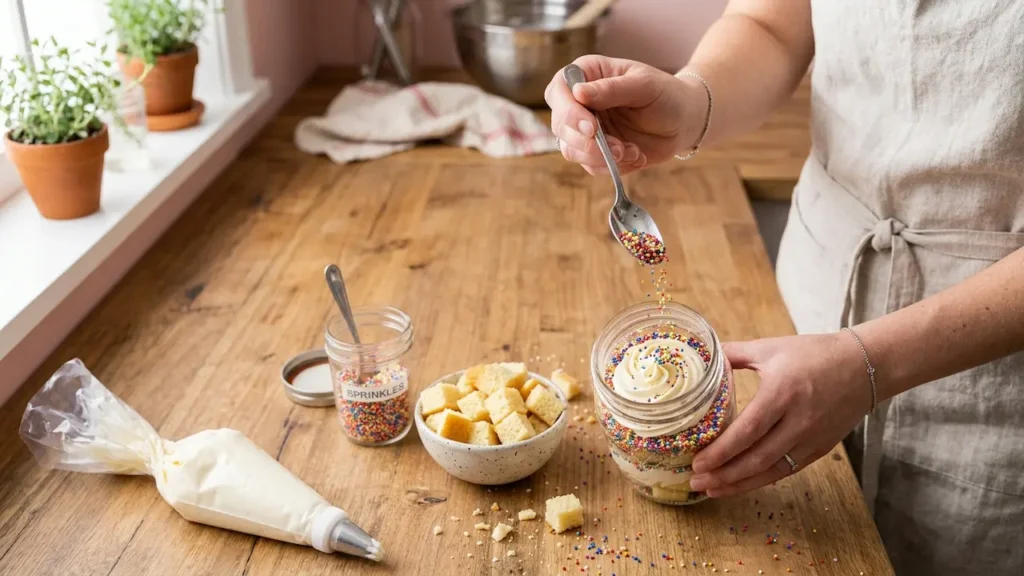
- Cut the cake. Once completely cool, cut the cake into approximately 2.5 cm (1 inch) cubes. You do not need perfect cubes: irregular pieces actually layer better because they fill gaps. Alternatively, use a round cookie cutter slightly smaller than the jar opening to cut cake rounds that sit in neat circles (more visually striking but produces more waste).
- Layer the first cake layer. Place a layer of cake pieces in the bottom of each jar, pressing gently to create a flat base. Fill to approximately one-quarter of the jar height.
- Add the first frosting layer. Spoon or pipe a generous layer of frosting over the cake, spreading to the edges of the jar. Use approximately 2 to 3 tablespoons of frosting per layer. If piping, a piping bag with a large round tip produces cleaner, more photogenic results.
- Add mix-ins. Sprinkle your chosen mix-ins (sprinkles, chips, fresh berries, or crushed cookies) over the frosting layer.
- Repeat layers. Add a second cake layer, a second frosting layer, and a second round of mix-ins. Most 8 oz jars accommodate two complete cake-frosting-mix-in cycles plus a top layer.
- Top and finish. Add a final layer of frosting on top. Decorate with a few whole or halved mix-ins for visual presentation: a line of sprinkles, a few whole chocolate chips, a strawberry slice, or a dusting of matcha. This top layer is what guests see when they receive the jar.
- Seal and refrigerate. Screw the lid on firmly. Refrigerate for at least 1 hour before serving to allow the layers to set and the frosting to firm slightly. This makes the shaking experience more satisfying: a properly chilled shaker produces clean, distinct mixed layers rather than an immediate slurry.
Recipe Card: Classic Vanilla Cake Shaker (CMS Plugin Format)
PrintClassic Vanilla Cake Shaker
Moist vanilla cake layered with fluffy buttercream and fun mix-ins in a portable mason jar. Shake before eating for a perfectly mixed individual dessert. Ready in 45 minutes. Makes 6 individual cake shakers. Refrigerates for up to 4 days.
- Prep Time: 20 minutes
- Cook Time: 25 minutes
- Total Time: 45 minutes
- Yield: 6 individual cake shakers (8 oz jars) 1x
- Category: Dessert, Baked Goods
- Method: Baking
- Cuisine: American
Ingredients
- 2¼ cups all-purpose flour
- 1½ cups granulated sugar
- 2½ teaspoons baking powder
- ½ teaspoon salt
- ½ cup unsalted butter, softened
- 2 large eggs
- 1 tablespoon vanilla extract
- 1 cup whole milk
- 1 cup vanilla buttercream frosting
- ½ cup rainbow sprinkles
- ½ cup mini chocolate chips (optional)
- 6 (8 oz) mason jars with lids
Instructions
- Preheat the oven to 350°F (175°C) and prepare a cake pan.
- Mix the flour, sugar, baking powder, and salt.
- Add the butter, eggs, vanilla extract, and milk, then mix until smooth.
- Bake for 25 minutes or until a toothpick inserted into the center comes out clean.
- Allow the cake to cool completely.
- Cut the cooled cake into bite-sized cubes.
- Add a layer of buttercream to the bottom of each mason jar.
- Add a layer of cake cubes.
- Sprinkle with rainbow sprinkles and chocolate chips if using.
- Repeat the layers until each jar is nearly full, leaving about 2 cm of space below the lid.
- Seal the jars and refrigerate for at least 1 hour.
- Shake well before serving and enjoy.
Notes
- Cake must be completely cool before assembly. Warm cake melts the frosting.
- Leave at least 2 cm of space below the lid to allow for shaking.
- Add fresh fruit only to jars that will be consumed within 24 hours.
- Refrigerate assembled shakers for at least 1 hour before serving for best shaking texture.
Nutrition
- Serving Size: 1 cake shaker
- Calories: 450
- Sugar: 35g
- Sodium: 280mg
- Fat: 20g
- Saturated Fat: 12g
- Unsaturated Fat: 7g
- Trans Fat: 0g
- Carbohydrates: 63g
- Fiber: 1g
- Protein: 5g
- Cholesterol: 75mg
Delicious Cake Shaker Flavor Variations
Chocolate Cake Shaker (Classic)
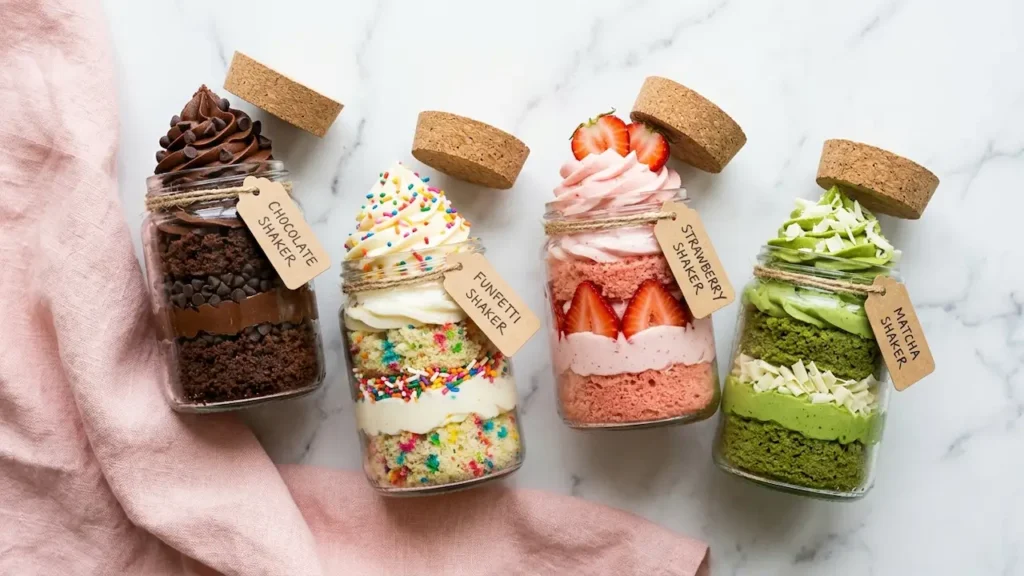
The most requested variation and arguably the most satisfying. Use a moist chocolate cake (substitute 40 g / 1/3 cup of the flour in the base recipe with unsweetened cocoa powder; add 60 ml of hot coffee to the batter to bloom the cocoa and deepen the chocolate flavor significantly). Pair with chocolate American buttercream (add 4 tablespoons of unsweetened cocoa powder to the base buttercream recipe). Between the layers: semi-sweet chocolate chips and crushed Oreo pieces. On top: a thin drizzle of warm ganache (equal parts dark chocolate and heavy cream, melted together). The result is what a professional chocolate layer cake experience feels like in individual jar form.
Funfetti Cake Shaker (Birthday Favorite)
Use the vanilla cake base recipe with one addition: fold 60 g (1/3 cup) of rainbow sprinkles into the batter at the end, before pouring into the pan. Bake as normal. The sprinkles bleed their color slightly into the surrounding cake during baking, creating the characteristic confetti pattern. Pair with plain vanilla buttercream. Layer with additional sprinkles between each frosting layer. Top with a generous covering of sprinkles and any themed toppers appropriate for the occasion. This is the variation most likely to produce visible delight in children and in adults who maintain a healthy relationship with nostalgia.
Strawberry Cake Shaker (Fresh and Fruity)
Two approaches work equally well for the cake component. Option 1: use the vanilla cake base and add 2 tablespoons of reduced homemade strawberry syrup to the batter before baking (this tints the cake a light pink and adds real strawberry flavor). Option 2: bake a plain vanilla cake and add fresh strawberry slices between the layers for the fruit element. Pair with strawberry cream cheese frosting: one cup of cream cheese frosting with 2 tablespoons of reduced strawberry syrup folded in. Our strawberry syrup recipe covers the quick 15-minute method. This variation is best consumed within 24 hours when using fresh strawberry slices.
Matcha Cake Shaker (Green Tea Elegance)
Add 2 tablespoons of sifted culinary-grade matcha powder to the vanilla cake base, replacing 2 tablespoons of flour. The batter will be slightly green; the baked cake, a muted sage green. The matcha flavor is subtle in the cake but pronounced in the frosting: for the matcha frosting, add 1 tablespoon of sifted matcha to the vanilla buttercream base. Top with a light dusting of matcha powder over the white frosting surface. White chocolate chips between layers complement the earthiness of the matcha. This is the most sophisticated and least sweet of the variations. Our matcha taho recipe covers the matcha quality and preparation guidance that applies equally to baked applications.
Red Velvet Cake Shaker (Romantic)
Red velvet is a complete cake recipe rather than a simple variation of vanilla, requiring buttermilk, a small amount of cocoa, and, traditionally, red food coloring (use gel food coloring for the most vibrant result or natural beet powder for an artificial-dye-free version). Pair exclusively with cream cheese frosting: the tangy cream cheese is the essential counterpoint to the mild cocoa and the sweetness of the cake. White chocolate shavings between layers and on top provide a color contrast against the red cake that is visually elegant. This is the variation for Valentine’s Day, anniversaries, and any occasion where the jar as a gift is the primary function.
Lemon Cake Shaker (Bright and Fresh)
Add the zest of 2 lemons and 2 tablespoons of fresh lemon juice to the vanilla cake base. The lemon zest (not just the juice) is what produces a truly lemony cake: the oils in the zest carry far more aromatic lemon flavor than the juice alone. For the frosting, use lemon cream cheese: standard cream cheese frosting with 1 tablespoon of lemon zest and 1 tablespoon of lemon juice added.
Between layers: fresh blueberries (in jars to be consumed within 24 hours) or dried blueberries (for longer storage). A blueberry option connects naturally to the antioxidant-rich approach in our flat-belly blueberry smoothie, and the tart-sweet combination of lemon and blueberry in a cake shaker is one of the genuinely excellent flavor pairings in this format.
Make-Ahead and Storage Guide
How Long Do Cake Shakers Last?
| Storage method | Shelf life | Notes |
| Room temperature (buttercream only) | 1 to 2 days | Only if no cream cheese, fresh fruit, or whipped cream |
| Refrigerated (all frosting types) | 3 to 4 days | Best quality in first 2 days; cake softens progressively |
| Frozen (without fresh fruit) | Up to 2 months | Thaw overnight in refrigerator; shake after thawing |
| With fresh fruit (refrigerated) | 24 hours maximum | Fresh berries release moisture; cake becomes soggy beyond 24 hours |
Best Practices for Storage and Transport
Refrigerating: Always leave the cake shaker jar completely sealed until serving. The airtight seal prevents the cake from absorbing refrigerator odors and slows moisture loss from the frosting. Wipe the outside of the jar dry before refrigerating if there are fingerprints or condensation: moisture on the outside of the jar promotes the lid corroding slightly in glass mason jars over several days.
Freezing: For freezing, leave 2 to 3 cm of headspace in the jar above the top frosting layer, as the frosting expands slightly when frozen. Do not freeze jars with fresh fruit: frozen then thawed berries are mushy and release significant moisture into the cake layers. Thaw frozen cake shakers in the refrigerator overnight, not at room temperature, to prevent condensation on the glass and uneven thawing.
Transporting: Cake shakers in sealed jars travel well in a standard cooler with ice packs. Stand them upright in the cooler in tight groups so they cannot tip. A muffin tin, with each jar sitting in a muffin cup, is an excellent transport organizer that fits in a standard cooler: six jars fit in a standard 6-cup muffin tin perfectly and cannot tip in any direction.
🛡️ Pro Tip: Prevent Soggy Cake Layers
The most common complaint about cake shakers made too far in advance is a soggy cake layer at the bottom of the jar where frosting moisture has had the longest exposure time. Here are two proven strategies to prevent this:
💡 Make-ahead tip: With these strategies, your cake shakers will stay fresh and delicious for up to 4 days refrigerated without any sogginess. Perfect for party prep!
Cake Shaker Gift Ideas
Packaging and Presentation
A cake shaker presented as a gift benefits from simple, deliberate packaging. The jar itself is already attractive; the presentation just needs to be intentional:
- Cut a circle of decorative fabric or parchment slightly larger than the lid and secure it over the lid with a rubber band before tying a ribbon over it.
- Print a small label with the flavor name, the date of assembly, and the “shake before eating” instruction. Attach to the jar with twine.
- Include a long-handled dessert spoon tied to the jar. This signals that the recipient has everything they need without opening it.
- For multiple jars going to the same recipient, group them in a small basket with crinkle paper and a handwritten note on the instruction card.
Occasion-Specific Flavor and Decoration Guide
| Occasion | Recommended flavor | Decoration style | Special touch |
| Birthday | Funfetti | Bright sprinkles, themed toppers | Age number written on lid label |
| Baby shower | Vanilla with pastel frosting | Pink or blue sprinkles, subtle palette | Small baby-themed topper |
| Wedding favor | Lemon or red velvet | Minimalist, gold or white | Elegant label with couple’s name and date |
| Valentine’s Day | Red velvet or strawberry | Red sprinkles, white chocolate hearts | Small love note tucked under ribbon |
| Holiday (Christmas) | Peppermint vanilla | Red and green sprinkles, candy cane piece | Festive ribbon, cinnamon stick tied on |
| Teacher gift | Chocolate | Simple, professional | Thank-you note, coffee packet tucked alongside |
Cost Breakdown
One of the strongest practical arguments for cake shakers as gifts is the cost efficiency relative to the perceived value:
- Wide-mouth mason jars (12-pack): approximately $12 to $16, or $1.00 to $1.35 per jar
- Vanilla cake ingredients for one 9×13 inch batch: approximately $5 to $8
- Buttercream ingredients for one batch (enough for 6 shakers): approximately $4 to $6
- Mix-ins and decorations (sprinkles, chips): approximately $2 to $4 for 6 shakers
- Total per shaker: approximately $2.00 to $2.60
A comparable individual dessert from a bakery or dessert shop costs $6 to $12. The difference in perceived value versus actual cost is substantial, which is part of why cake shakers work so well as gifts: they look and feel like something that cost considerably more than they did.
Frequently Asked Questions About Cake Shakers
Do you actually shake a cake shaker before eating?
Yes, and the shaking is the point, not just the name. A properly assembled cake shaker with chilled, firm frosting layers will, when shaken vigorously for 10 to 15 seconds, mix the cake, frosting, and mix-ins into a cohesive, creamy dessert where every spoonful contains all components in roughly equal proportion. The pre-shake jar is for looking at; the post-shake contents are for eating. The jar needs to be at least one-third empty above the top layer for effective shaking: if the jar is overfilled to the rim, there is no room for the contents to move and the shaking is ineffective. This is why leaving headspace during assembly is important.
Can I make cake shakers ahead of time?
Yes, and this is one of their strongest practical advantages. Assembled and sealed cake shakers refrigerate for 3 to 4 days without quality loss. The cake actually benefits from 12 to 24 hours of refrigeration: the frosting softens the surrounding cake slightly, creating a more uniform texture throughout the jar. For events, assemble the shakers up to 2 days in advance, refrigerate them sealed, and transport them in a cooler with ice packs. The only exception is fresh fruit mix-ins: add fresh berries or sliced strawberries only to jars that will be consumed within 24 hours of assembly.
Do cake shakers need refrigeration?
It depends on the frosting. American buttercream (butter, powdered sugar, and cream) contains no perishable dairy ingredients and is technically shelf-stable for 1 to 2 days at room temperature. Cream cheese frosting requires refrigeration at all times; cream cheese is a dairy product with a short safe window outside of refrigeration. Whipped cream requires refrigeration from the moment it is applied. When in doubt, refrigerate. Refrigeration also improves the texture of the shaker by firming the frosting layers, which makes the shaking more effective and the mixed result more satisfying.
What jar size is best for cake shakers?
An 8 oz (240 ml) wide-mouth mason jar is the standard for one generous individual serving. This size accommodates two complete cake-frosting-mix-in cycles plus a top frosting layer with approximately 2 cm of headspace for shaking. A 12 oz (360 ml) jar is appropriate for larger portions or for variations with multiple mix-in layers that add volume. Wide-mouth is non-negotiable: regular-mouth mason jars are too narrow for comfortable eating with a spoon and for assembling layers with any precision. Pint-sized (16 oz) jars are typically too large for a single dessert portion and produce an overwhelming serving unless shared.
Can I freeze cake shakers?
Yes, without fresh fruit or whipped cream. Buttercream and cream cheese frosting both freeze and thaw well; the texture changes slightly (cream cheese frosting can become slightly grainy after freezing, which is resolved by stirring after thawing), but the flavor is preserved. Leave 2 to 3 cm of headspace in the jar before freezing to allow for expansion. Thaw in the refrigerator overnight, not at room temperature. After thawing, the cake will be softer than a fresh shaker but still pleasant. Frozen cake shakers are most useful for batch cooking for future gifts; for immediate serving, freshly assembled and chilled is always better.
How do I prevent the cake from getting soggy?
The soggy bottom problem comes from frosting moisture migrating into the cake layer over time. Four strategies address it: (1) Use a slightly drier cake by reducing the liquid component (milk or buttermilk) by about 10%. (2) Add a thin barrier of crushed cookies or graham crackers between the jar bottom and the first cake layer; the crumbs absorb moisture before the cake does. (3) Apply frosting in firm, not warm or runny layers; frosting that is too soft immediately begins saturating the adjacent cake. (4) Consume within 2 days for the best texture; the cake is at its best in the first 24 to 48 hours and progressively softer (though still good) beyond that.
Can I use boxed cake mix for cake shakers?
Yes, and boxed mix works extremely well for this format. The slight structural difference between boxed mix cake and scratch cake (boxed mix tends to be slightly spongier and more moisture-retentive due to the added stabilizers) actually benefits the shaker format, where absorbing some frosting moisture is a feature rather than a flaw. If using boxed mix, follow the package instructions exactly. The most common improvement you can make to a boxed mix is the “doctored” approach: replace the water with whole milk, add an extra egg yolk, and replace the vegetable oil with melted butter. This produces a richer, more homemade-tasting cake from a boxed starting point.
Common Mistakes That Ruin Cake Shakers
Using Warm Cake
This is the mistake that collapses the entire assembly. Warm cake placed directly into a jar with frosting immediately begins melting the frosting into a liquid, which then soaks into the still-warm cake, producing a homogeneous mush with no distinct layers and a heavy, dense texture. The cake must be completely cool, at room temperature throughout (including the center, which retains heat longer than the exterior), before any assembly begins. Minimum cooling time on a wire rack: 1 hour after removing from the pan. If you are impatient, cut the cake into pieces and spread them on the rack to cool faster. The golden rule: if the cake is warm to the touch anywhere, it is not ready.
Overfilling the Jar
The most common first-attempt error. A cake shaker filled to the rim has no room for its contents to move during shaking, which means the shaking instruction produces no mixing and a frustrating experience for the person eating it. Leave a minimum of 2 cm and ideally 3 cm of space between the top frosting layer and the inside of the lid. This space is what allows the contents to shift, tumble, and combine when the jar is turned and shaken. The lid should close easily without pressing down on the frosting.
Too Much Frosting
More frosting is not automatically better. A cake shaker with frosting making up more than 40% of the total volume by weight will taste predominantly of frosting after shaking, with the cake playing a supporting role. The ideal ratio is roughly 1 part frosting to 2 parts cake to 0.5 parts mix-ins by volume. Frosting provides the creamy element; the cake provides the structure and base flavor. When in doubt, use less frosting per layer: you can always add more on top for visual generosity without unbalancing the internal ratio.
Using Runny Frosting
Frosting that is too warm, too thin, or not adequately beaten will slide through the cake layers during assembly rather than sitting as a distinct layer. The result is a jar where the frosting has settled to the bottom, the cake is dry and unfrosted, and the layered visual is absent. Frosting for cake shakers should be thick enough to hold a peak when lifted by a spoon and should be at room temperature (not warm). If your frosting is too thin, add powdered sugar one tablespoon at a time and beat until the correct consistency is reached. If it is too stiff (this is less common), add cream one teaspoon at a time.
Not Sealing Properly
A cake shaker that is not properly sealed is a mess waiting to happen, particularly during transport. Always hand-tighten the lid until it stops, then give one additional firm turn. For cake shakers intended for travel or shipping, add a small square of plastic wrap over the jar opening before screwing on the lid: this provides a secondary seal that prevents leaks even if the lid loosens during handling. If gifting in a bag or box, pack the jar upright with padding on all sides.
Conclusion: Your New Favorite Portable Dessert
Cake shakers are one of those formats where the concept and the execution align perfectly. The concept is simple enough to explain in one sentence (cake in a jar; shake before eating), the execution is within reach of anyone who can bake a basic cake, and the result is genuinely impressive in a way that individual desserts often are not.
Start with the classic vanilla version, which gives you the cleanest foundation for understanding how the layers work, what the right frosting consistency feels like, and how the shaking actually transforms the jar. Then move to whatever flavor variation matches the occasion. The chocolate version for maximum crowd appeal, the lemon-blueberry for sophisticated summer parties, the funfetti for anything with children or anyone who enjoys being reminded that cake is supposed to be fun.
The gifting application is worth exploring seriously. At $2 to $3 per jar, a personalized cake shaker with a hand-applied label and a tied ribbon competes with gifts costing three to four times as much in terms of perceived thoughtfulness, and it is something the recipient will eat rather than store. That is a meaningful practical advantage in the gift economy.
📖 Related Reading: Your Dessert & Baking Toolkit
Explore homemade syrups, flavor variations, and balanced dessert ideas
🍓 Strawberry Syrup Recipe
Homemade strawberry syrup for the strawberry cake shaker variation and for flavoring buttercream and cream cheese frosting naturally.
🍵 Matcha Taho Recipe
Matcha quality guidance and preparation technique that applies equally to the matcha cake shaker variation.
🟣 Ube Halaya Recipe
Homemade purple yam jam that can be swirled into buttercream or cream cheese frosting for an ube cake shaker variation.
🥜 Mark Hyman Snack Ideas
The Pegan framework for mindful eating that provides context for cake shakers as deliberate, portion-controlled treats within a balanced food life.
🫐 Flat Belly Blueberry Smoothie
Blueberries as the featured mix-in for the lemon cake shaker variation, with the nutritional background on why blueberries are the best berry for baking applications.
🍇 Purple Peel Weight Loss
The anthocyanin science behind blueberries, ube, and other purple-pigmented ingredients that feature in cake shaker variations.
🎂 More baking and dessert guides at JoyfulBiteRecipes.com