
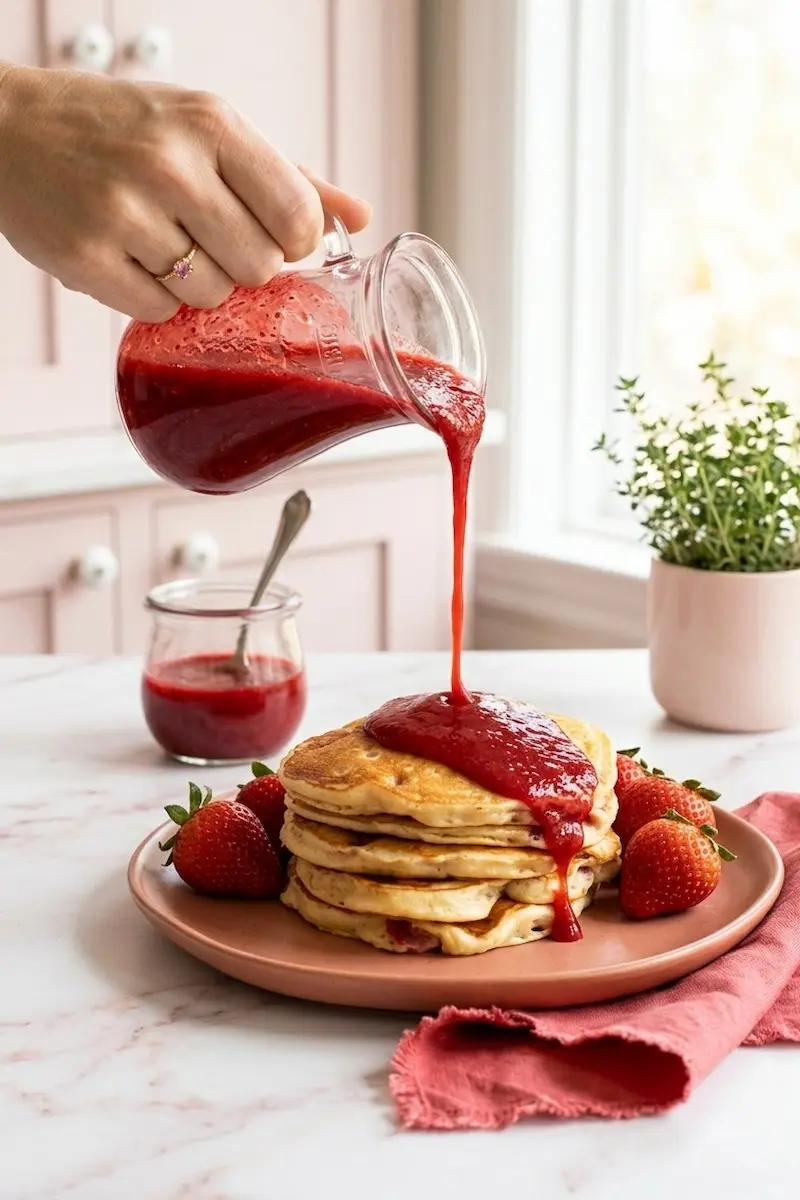
Homemade strawberry syrup is one of those kitchen preparations that costs almost nothing to make, takes 15 minutes, and immediately makes you wonder why you ever bought the commercial version. The bottled syrups available at most grocery stores rely on artificial strawberry flavoring, red dye, and high-fructose corn syrup to approximate the flavor of the real thing. They do not succeed. Real strawberry syrup, made from actual strawberries, tastes nothing like them.
This strawberry syrup recipe covers three methods: the classic stovetop approach for the best all-purpose syrup, a sugar-free version using natural sweeteners for people managing blood sugar or reducing refined sugar intake, and a no-cook blended method for when you need something immediately without any cooking. Each method produces a genuine, fresh-tasting strawberry syrup that you can use for taho, milk tea, pancakes, lemonade, cocktails, desserts, and a dozen other applications.
The whole thing is four ingredients. Here is how to make it properly in all three formats, store it to maximize shelf life, and use it across the widest possible range of applications.
Table of Contents
Quick Answer: The Perfect Strawberry Syrup
🍓 At a Glance: Strawberry Syrup
What Is Strawberry Syrup and Why Make It at Home?
The Versatile Sweet Condiment
Strawberry syrup is a concentrated liquid sweetener made by extracting the juice and flavor from strawberries and combining it with a sweetener (usually sugar) in a ratio that produces a pourable, stable, intensely flavored liquid. Unlike strawberry jam or preserves, which are thick and set, a well-made strawberry syrup is pourable at room temperature and disperses evenly through liquids, making it ideal as a drink sweetener, a dessert topping, a cocktail component, or a breakfast condiment.
The applications span an unusually wide range: poured over warm silken tofu for a fresh strawberry taho, stirred into iced milk tea, drizzled over pancakes, swirled into plain yogurt, mixed into lemonade, or used as a cocktail base. This versatility is what makes a batch worth making: one 15-minute session produces a condiment that covers a week or more of different uses.
Why Homemade Strawberry Syrup Beats Store-Bought
Commercial strawberry syrups are made to a different set of priorities than homemade ones. Shelf life (months, not weeks), color stability under supermarket lighting, standardized sweetness regardless of berry quality, and cost of goods are the primary design constraints. Achieving these requires artificial flavoring, synthetic red dyes (usually Red 40), and preservatives. The resulting flavor is identifiable as “strawberry” in the way a strawberry-scented candle is identifiable as strawberry: recognizable, but not the thing itself.
Homemade fresh strawberry syrup tastes like concentrated strawberries. The difference is not subtle. The color, a deep, natural red-pink with no synthetic brightness, is also noticeably different. And the control over sweetness is genuinely useful: reducing the sugar by 20% produces a tarter, more fruit-forward syrup; increasing it slightly produces a richer, more dessert-appropriate one. You can tune it to exactly what you need.
For a comparison with another homemade syrup base, our ube halaya recipe covers the same principle applied to Filipino purple yam jam: three methods, complete control over sweetness and texture, and a result that is meaningfully better than any commercial alternative.
Fresh vs Frozen Strawberries: Which to Use
| Fresh strawberries | Frozen strawberries | |
| Flavor | Brighter, more aromatic when in season | Consistent year-round; picked and frozen at peak ripeness |
| Cost | Higher, especially out of season | Lower and consistent year-round |
| Availability | Seasonal in most regions | Available year-round |
| Preparation | Wash, hull, halve | Thaw slightly or use directly from frozen (add 2-3 min. cooking). |
| Moisture content | Less liquid released | Releases more liquid; slightly more yield per cup |
| Best for | Peak summer syrup; gifting | Everyday batch cooking; winter use |
| Verdict | Marginally better flavor in season | Equal nutritional value; practical for most uses |
💡 Key Insight: Frozen vs Fresh Strawberries
Outside of peak berry season (May to July in North America), frozen strawberries are often superior for syrup-making. Here’s why:
💡 Rule of thumb: A strawberry syrup made from frozen berries in January will often taste better than one made from fresh supermarket strawberries in December.
The Science of Perfect Strawberry Syrup
Pectin, Heat, and Syrup Consistency
Strawberries contain natural pectin, a soluble fiber that forms a gel when heated in the presence of sugar and acid. In jam-making, pectin is exploited to create a firm set. In syrup-making, the goal is to extract enough pectin to give the syrup body and mouthfeel without allowing it to gel. This is achieved by controlling the ratio of fruit to sugar, the cooking temperature, and the cooking time.
A ratio of one part sugar to one part water (plus the liquid released by the strawberries during cooking) produces a standard simple syrup consistency: pourable, slightly viscous, and stable at room temperature and refrigerator temperatures. Increasing the sugar ratio to 2:1 (sugar to water) produces a thicker, richer syrup with a longer shelf life. Decreasing it produces a thinner, lighter syrup that disperses more readily in cold drinks.
Lemon juice serves two functions: it provides the acidity that helps activate the pectin, and it lowers the pH of the syrup, which preserves the red anthocyanin pigments and extends shelf life by inhibiting microbial growth. A syrup made without lemon juice will brown faster, fade to an orangish-pink more quickly, and have a shorter refrigerator shelf life.
Sugar’s Role Beyond Sweetness
Sugar in a syrup is not purely a sweetening agent. At the concentrations used in simple syrup (roughly 50% by weight), sucrose creates an environment that inhibits microbial growth by reducing the water activity available for bacterial and mold metabolism. This is the same principle that makes jams and honeys shelf-stable: the sugar binds water molecules and makes them unavailable to microorganisms.
Sugar also contributes to the viscosity and mouthfeel of the syrup: a sugar-free syrup made with low-calorie sweeteners will always feel thinner in the mouth than a sugar-based one, because the bulking and viscosity contributions of sucrose cannot be fully replicated by sweeteners used at much lower concentrations. For the sugar-free method, adding a small amount of xanthan gum (1/8 teaspoon per cup of liquid) compensates for this difference.
For readers interested in reducing added sugar across their daily eating patterns, our Mark Hyman snack ideas guide covers the Pegan approach to sweeteners and the difference between naturally occurring fruit sugars and added refined sugars in the context of blood sugar management.
Color Retention: Keeping Strawberry Syrup Vibrantly Red
Strawberry’s red color comes from anthocyanins, the same class of polyphenolic pigments found in blueberries, red cabbage, and purple yam. Strawberry anthocyanins are particularly sensitive to heat, light, and pH changes. Without protective measures, a strawberry syrup will shift from bright red toward a dull orangish-brown within a few days.
Three techniques preserve the red color: adding lemon juice (maintains the acidic pH at which red anthocyanin structures are stable), minimizing cooking time (shorter heat exposure degrades fewer pigment molecules), and storing in opaque or dark glass containers away from direct light. Our purple peel weight loss guide covers the broader anthocyanin science in depth, including the pH sensitivity of these compounds across different purple and red plant foods.
The Best Strawberry Syrup Recipe: 3 Methods
The Functional Ingredient Stack
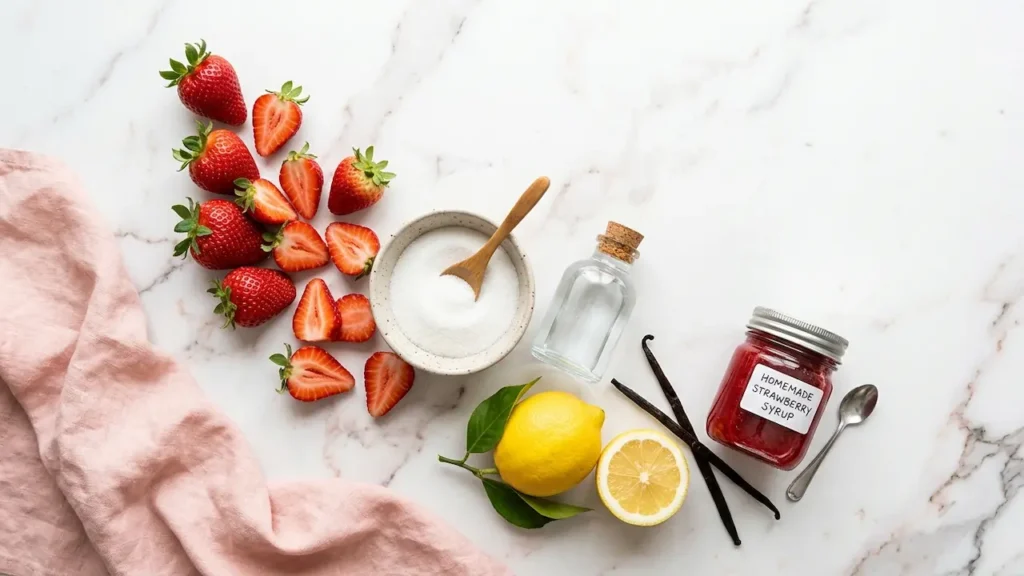
| Ingredient | Amount | Notes |
| Fresh or frozen strawberries | 300 g (2 cups, hulled and halved) | Frozen: thaw slightly and include released juices |
| Water | 240 ml (1 cup) | Filtered water preferred; tap water fine |
| Sugar (for classic method) | 200 g (1 cup) | White sugar: cleanest flavor; muscovado: caramel depth; coconut sugar: mild molasses note |
| Fresh lemon juice | 1 tablespoon | Not bottled, fresh lemon juice has meaningfully better flavor and more active pectin-activating acidity |
| Vanilla extract (optional) | 1 teaspoon | Adds warmth and rounds the flavor; omit for a cleaner, more purely strawberry result |
| Pinch of sea salt | A pinch | Optional but recommended; sharpens and amplifies the strawberry flavor noticeably |
| Monk fruit / erythritol (Method 2) | 150 to 180 g (3/4 cup equivalent) | Sweetness varies by brand; start lower and taste |
| Xanthan gum (Method 2 optional) | 1/8 teaspoon | Compensates for reduced viscosity in sugar-free version; dissolve in water before adding |
Method 1: Classic Stovetop Strawberry Syrup
Total time: 5 minutes prep + 12 to 15 minutes cooking. Best for: all-purpose use, longest shelf life, fullest flavor.
- Prepare the strawberries. If using fresh ones: wash, hull, and halve them. If using frozen, thaw until they begin to release juices (approximately 30 minutes at room temperature or overnight in the refrigerator), and include all released liquid in the measurement.
- Combine strawberries and water. Place the prepared strawberries and the water in a medium, non-reactive saucepan (stainless steel or enamel; avoid aluminum, which can react with the acid). Bring to a boil over medium heat, then reduce to a steady simmer.
- Simmer and mash. Simmer for 8 to 10 minutes, stirring occasionally. As the strawberries cook, they will release their juice and begin to break down. After 8 minutes, gently mash the softened strawberries with a potato masher or the back of a spoon to extract as much juice as possible. Do not cook for more than 12 minutes: beyond this point the fresh strawberry flavor diminishes and the syrup begins to taste more like cooked jam than fresh fruit.
- Strain. Pour the mixture through a fine-mesh sieve set over a bowl or measuring jug. Press the strawberry solids firmly with a spoon or the back of a ladle to extract as much liquid as possible. Discard the solids (or reserve them for stirring into yogurt or oatmeal). You should have approximately 300 to 360 ml (1.25 to 1.5 cups) of deep red strawberry liquid.
- Add sugar and dissolve. Return the strained liquid to the saucepan. Add the sugar. Heat over medium-low heat, stirring constantly, for 2 to 3 minutes until the sugar is completely dissolved. Do not allow it to boil at this stage: boiling after adding sugar can cause crystallization later.
- Add lemon juice and finish. Remove from heat. Stir in the fresh lemon juice, vanilla extract (if using), and sea salt. Taste and adjust sweetness: if too tart, add sugar one tablespoon at a time and stir until dissolved over low heat. If too sweet, add lemon juice in small increments.
- Cool and store. Allow the syrup to cool to room temperature before transferring to a sterilized glass bottle or jar. Do not seal while hot: condensation inside a sealed hot jar creates moisture that accelerates spoilage. Store refrigerated and use within 2 to 3 weeks.
Pro Tip: Perfect Syrup Consistency (Classic Method)
The most common consistency problem with the classic method is a syrup that is too thin. Here’s how to fix it:
💡 Pro trick: If your syrup is still too thin after cooling, simply reheat and reduce further. You can always thicken it, but you can’t undo over-reduction!
Method 2: Sugar-Free Strawberry Syrup
Total time: Same as the classic method, 15 minutes. Best for: people managing diabetes or blood sugar, low-carb eating patterns, or anyone reducing refined sugar intake.
Steps 1 through 4: Identical to the classic method. Prepare, cook, mash, and strain the strawberries exactly as described above.
Step 5: Sweeten with a natural alternative.
Add the sweetener to the strained strawberry liquid and heat over low heat, stirring until fully dissolved. The specific sweetener affects the final result:
- Monk fruit extract: Clean, neutral sweetness with no aftertaste in most people. Use 1.5 to 2 teaspoons of liquid monk fruit (or equivalent dry measure per package instructions). Highly concentrated; add in small increments and taste. Does not caramelize or crystallize.
- Erythritol: A sugar alcohol with a bulk similar to sugar, making it the easiest substitute for texture purposes. Use 150 g (3/4 cup) per batch. Has a slight cooling sensation that some people notice; less pronounced when combined with strawberry flavor. Can crystallize in the refrigerator; allow to warm slightly before use if this occurs.
- Allulose: The best sugar-free substitute for caramel-style cooking and for syrups where viscosity is important. Behaves most like sugar in terms of texture and mouthfeel. Use at a 1:1 ratio by volume. Limited availability in some regions.
- Stevia: The most widely available option. Use liquid stevia at 10 to 15 drops per batch or powdered stevia at a 1/4 teaspoon equivalent. Can have a bitter aftertaste at higher concentrations; if noticeable, combine with a small amount of erythritol.
Step 6: Add lemon juice, vanilla, and salt as in the classic method. If using erythritol or another bulk sweetener and the syrup feels thin compared to the sugar version, add 1/8 teaspoon of xanthan gum dissolved in one tablespoon of cold water and stir into the warm syrup. This restores much of the viscosity without affecting flavor.
The sugar-free version has a slightly shorter shelf life than the classic (1 to 2 weeks rather than 2 to 3 weeks) because it lacks the preservative effect of dissolved sugar.
Method 3: No-Cook Strawberry Syrup
Total time: 5 minutes. Best for immediate use, when you want the freshest possible strawberry flavor, or when cooking time is not available.
- Make a simple syrup separately. Combine 200 g (1 cup) sugar with 240 ml (1 cup) water in a small saucepan. Heat over medium heat, stirring, until the sugar is completely dissolved, approximately 3 minutes. Remove from heat and cool to room temperature. This simple syrup can be made in advance and kept in the refrigerator for up to a month.
- Blend the strawberries. Place 300 g of ripe fresh strawberries (washed and hulled) in a blender. Add the tablespoon of lemon juice. Blend on high for 30 to 45 seconds until completely smooth.
- Combine and taste. Stir the blended strawberry puree into the cooled simple syrup. Taste and adjust the ratio: more puree for a more intensely fruity, less sweet syrup; more simple syrup for a sweeter, thinner result.
- Strain (optional). For a smooth, seed-free syrup, pour through a fine-mesh sieve and press to extract liquid, discarding solids. For a thicker, more textured syrup (excellent for pancakes and desserts), skip straining and use as-is.
The no-cook syrup has a shorter shelf life (3 to 5 days refrigerated) because the raw fruit introduces bacteria and enzymes not deactivated by heat. Use it within a week and make small batches as needed.
PrintHomemade Strawberry Syrup
Fresh, vibrant homemade strawberry syrup made three ways: classic stovetop for the best all-purpose result, sugar-free for a healthier alternative, and no-cook blended for immediate use. Ready in 15 minutes with no artificial colors or flavors. Perfect for taho, milk tea, pancakes, cocktails, desserts, and more.
- Prep Time: 5 minutes
- Cook Time: 10 minutes
- Total Time: 15 minutes
- Yield: 20 to 25 servings 1x
- Category: Condiment
- Method: Stovetop
- Cuisine: American
- Diet: Gluten Free
Ingredients
- 300 g (2 cups) fresh or frozen strawberries, hulled and halved
- 240 ml (1 cup) water
- 200 g (1 cup) white sugar
- 150 g erythritol or 1½ tsp liquid monk fruit (for sugar-free version)
- 1 tablespoon fresh lemon juice
- 1 teaspoon pure vanilla extract (optional)
- Pinch of sea salt
Instructions
- Wash, hull, and halve the strawberries.
- Add strawberries, water, sugar, lemon juice, and sea salt to a saucepan.
- Bring the mixture to a gentle simmer over medium heat.
- Cook for 8 to 10 minutes, stirring occasionally, until the strawberries soften completely.
- Mash the berries lightly with a spoon or potato masher.
- Remove from heat and stir in vanilla extract if using.
- Strain through a fine-mesh sieve for a smooth syrup, or leave slightly pulpy if preferred.
- Allow the syrup to cool completely.
- Transfer to a clean glass jar or bottle.
- Refrigerate before serving.
- For the sugar-free version, replace sugar with erythritol or monk fruit sweetener.
- For the no-cook version, blend all ingredients until smooth and strain if desired.
- Use over taho, pancakes, waffles, desserts, milk tea, lemonade, or cocktails.
Notes
- Refrigerator shelf life: 2 to 3 weeks for the classic version.
- Sugar-free version keeps 1 to 2 weeks refrigerated.
- No-cook version should be consumed within 3 to 5 days.
- Freeze for up to 6 months in airtight containers.
- Freeze in ice cube trays for convenient portioning.
- Allow syrup to cool completely before sealing and storing.
- Always use a clean spoon when serving to prevent contamination.
- Add extra lemon juice for a brighter flavor.
- For thicker syrup, simmer an additional 3 to 5 minutes.
- For thinner syrup, stir in a small amount of water after cooling.
Nutrition
- Serving Size: 2 tablespoons
- Calories: 50
- Sugar: 11g
- Sodium: 5mg
- Fat: 0g
- Saturated Fat: 0g
- Unsaturated Fat: 0g
- Trans Fat: 0g
- Carbohydrates: 12g
- Fiber: 0g
- Protein: 0g
- Cholesterol: 0mg
Strategic Uses for Strawberry Syrup
Filipino Desserts and Drinks
Strawberry syrup integrates naturally into the Filipino dessert tradition as a modern, fruit-forward alternative to arnibal (the classic brown sugar syrup). The same layered taho format that works with ube or matcha syrup works equally well with a fresh strawberry version: warm silken tofu, cooked tapioca pearls, and two to three tablespoons of strawberry syrup poured over the top. The result is lighter and more summery than either the ube or matcha versions, with a bright acidity from the lemon juice that cuts through the neutrality of the tofu in a different way than earthier syrups do. Our ube taho recipe covers the full taho preparation technique, including the tofu warming and tapioca pearl methods.
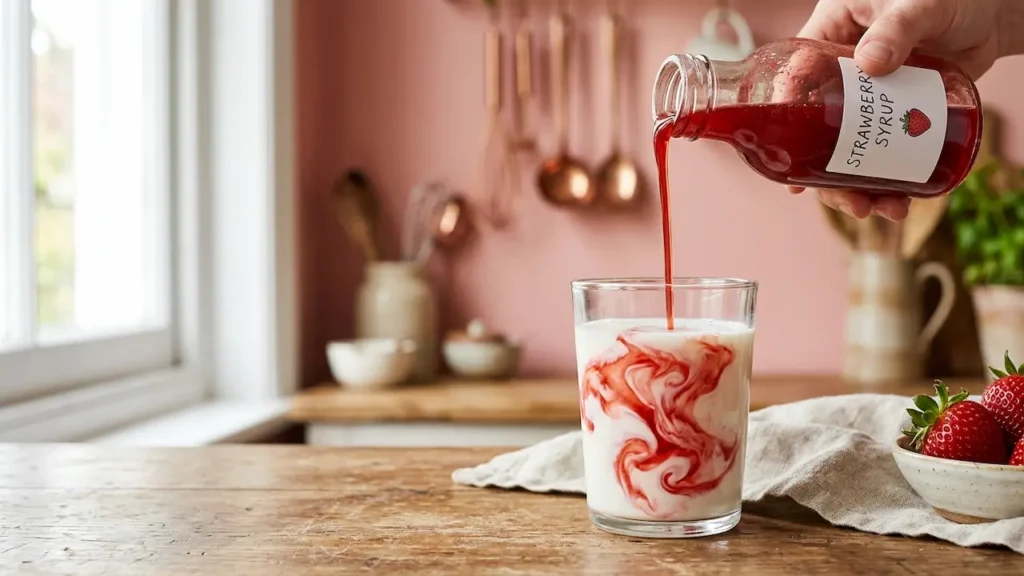
In strawberry milk tea, the syrup replaces commercial flavored syrups as the sweetening and flavoring agent. Add two to three tablespoons of fresh strawberry syrup to a glass of strongly brewed black tea with milk and ice for a dramatically better result than any bottled strawberry milk tea mix. For halo-halo, strawberry syrup can be drizzled directly over the shaved ice alongside the other components as a color and flavor accent. For Filipino leche flan, a thin pour of strawberry syrup alongside the caramel layer creates a strawberry-caramel combination that is particularly good.
Breakfast and Brunch
The classic application. Strawberry syrup poured over buttermilk pancakes or waffles is a significant upgrade over maple syrup for anyone who enjoys fruit flavors at breakfast, and it pairs particularly well with the slight tang of buttermilk. For French toast, warm the syrup slightly before pouring so it soaks into the bread rather than sitting on the surface. Swirled into plain whole-milk yogurt, one tablespoon of syrup per 150-gram serving is enough to flavor and color the yogurt without overwhelming it. As a smoothie sweetener, strawberry syrup replaces honey or agave with fruit flavor and less neutral sweetness.
Beverages and Cocktails
Strawberry syrup for drinks is where homemade really earns its place. Commercial strawberry syrups used in cocktails produce a candy-like, artificial sweetness; homemade fresh strawberry syrup has the actual flavor of the fruit and integrates into drinks as a genuine flavor component rather than just a colorant.
For strawberry lemonade: combine 60 ml (4 tablespoons) of strawberry syrup with 240 ml of freshly squeezed lemon juice, then add still or sparkling water to taste and serve over ice. For iced tea: add two tablespoons per glass of strong-brewed tea, stir, and serve cold. For cocktails: strawberry syrup replaces the grenadine or simple syrup in daiquiris, mojitos, margaritas, and Aperol spritz variations for a fruit-forward variation. It mixes with gin, vodka, and rum equally well.
Baking and Desserts
Strawberry syrup used as a cake filling should be reduced slightly more than the standard recipe (simmer for an additional 5 to 8 minutes after adding sugar) to produce a thicker consistency that will not soak through the cake layers. As an ice cream topping, warm the syrup briefly before serving: cold syrup poured over cold ice cream solidifies too quickly to distribute evenly. For cheesecake swirl, stir 3 to 4 tablespoons of syrup into 60 ml of the cheesecake batter before adding it back in streaks for a marbled effect. As a macaron filling, reduce the syrup to a jam-like consistency (roughly half the standard volume) and combine with buttercream.
Strawberry Syrup Variations and Flavor Twists
Strawberry-Vanilla Syrup
Add a split and scraped vanilla bean pod to the saucepan with the strawberries and water at the beginning of cooking. Remove and discard after straining. Alternatively, add one teaspoon of pure vanilla extract off-heat at the end. The vanilla deepens the strawberry flavor and adds a warmth that makes this version particularly well-suited to waffles, ice cream, and dessert applications. This is the most universally appealing variation and a good starting point if you want to experiment beyond the classic.
Strawberry-Basil Syrup
Add six to eight large fresh basil leaves to the saucepan for the final 3 minutes of cooking, then remove them before straining. The basil imparts a faintly peppery, herbal quality that contrasts with the sweetness of the strawberry in a sophisticated way. This version is particularly well-suited to cocktails (strawberry-basil gin and tonics and strawberry-basil lemonades) and to pairing with fresh mozzarella or ricotta as a savory-sweet application. Do not cook the basil for more than 3 minutes; a longer infusion produces a bitter, chlorophyll-heavy flavor.
Strawberry-Lemon Syrup
Double the lemon juice (two tablespoons instead of one) and add one teaspoon of fresh lemon zest to the syrup off-heat. This version leans tart and bright, with the citrus amplifying the natural acidity of the strawberries. It disperses more readily in cold drinks and has an almost refreshing quality that makes it the best of the variations for lemonades, sparkling water additions, and summer cocktails. The extra acid also extends the shelf life slightly.
Strawberry-Chili Syrup
Add a small piece of fresh red chili (approximately 2 cm, seeds removed for milder heat, seeds included for more) to the saucepan with the strawberries. Remove before straining. Alternatively, add 1/4 teaspoon of cayenne pepper when combining the strained liquid with sugar. The heat from the chili amplifies the fruitiness of the strawberry in a way that is counter-intuitive but genuinely effective. This version works in cocktails (strawberry margarita with chili salt rim), as a glaze for grilled chicken or shrimp, and drizzled over dark chocolate ice cream.
Strawberry-Rose Syrup
Add one tablespoon of rose water (not rose extract, which is much more concentrated) to the finished syrup off-heat, and stir to combine. Taste: The rose should be a subtle floral note, not the dominant flavor. If it is too pronounced, add additional strawberry syrup to dilute. This version is particularly appropriate for Middle Eastern-inspired desserts, elegant cocktails, and iced milk teas. Dried food-grade rose petals steeped for 5 minutes in the hot strained liquid before adding sugar produce a more subtle floral note than rose water if you prefer a softer touch.
Frequently Asked Questions About Strawberry Syrup
How long does homemade strawberry syrup last?
Classic stovetop strawberry syrup keeps for 2 to 3 weeks refrigerated in a sterilized, sealed glass container. The combination of dissolved sugar (which reduces water activity and inhibits microbial growth), lemon juice (which maintains an acidic pH hostile to most bacteria and molds), and refrigeration produces a stable product over this window. The sugar-free version lasts 1 to 2 weeks because the preservative effect of sugar is absent. The no-cook version lasts only 3 to 5 days because raw fruit introduces enzymes and microorganisms not deactivated by heat. In all cases, always use a clean spoon when serving and never introduce other substances into the jar. If you see mold, clouding, or an off smell, discard the entire batch.
Can I freeze strawberry syrup?
Yes, and freezing is the best way to extend a large batch significantly. Frozen strawberry syrup keeps well for up to 6 months without meaningful flavor degradation. The most practical method: pour the cooled syrup into ice cube trays and freeze until solid, then transfer the cubes to a labeled freezer bag. Standard ice cube portions are approximately one tablespoon each, making it easy to grab the exact amount needed without thawing an entire jar. To use, thaw in the refrigerator overnight or at room temperature for 30 minutes. The thawed syrup may look slightly less vibrant (some anthocyanin color degradation occurs during freezing) but will taste essentially the same.
Why is my strawberry syrup too thin or too thick?
Too thin is the most common issue and has two main causes: insufficient reduction (remove the strained liquid to the pan, add sugar, and simmer for 5 to 10 minutes longer, stirring frequently, until the syrup coats the back of a spoon) or using strawberries with high water content (frozen strawberries that were not well drained or berries with a lot of juice). Too thick is typically caused by over-reduction or too high a sugar ratio. Fix: add warm water, one tablespoon at a time, stirring over low heat until the desired consistency is restored. Remember that both issues are easier to assess accurately when the syrup is cold: test a spoonful on a cold plate rather than judging the hot liquid directly.
Can I use frozen strawberries for homemade strawberry syrup?
Yes, and for most purposes, they work just as well as fresh. The key difference is moisture: frozen strawberries release significantly more liquid as they thaw and cook, which means you may end up with more strained liquid per cup of berries than with fresh. This is actually advantageous for syrup yield. Include all the released juices in the saucepan. If using frozen berries, extend the simmering time slightly (to 12 minutes rather than 8 to 10) to ensure full flavor extraction, as the cell walls are more broken down by freezing and may release their flavor more quickly but also require a little longer to fully integrate.
Is strawberry syrup healthy?
In reasonable serving amounts (one to two tablespoons), classic strawberry syrup is a relatively benign condiment. Two tablespoons provides approximately 45 to 55 calories and 10 to 12 grams of sugar, which is less than most commercial salad dressings and comparable to a teaspoon of honey. It also retains some strawberry anthocyanins and vitamin C, though these are reduced by the cooking process. For people managing diabetes, blood sugar, or simply reducing refined sugar intake, the sugar-free version delivers the flavor of fresh strawberry syrup without the glycemic impact. Homemade syrup of either kind is considerably healthier than commercial versions that use high-fructose corn syrup and artificial additives.
Can I make strawberry syrup without sugar?
Yes, as described in Method 2 above. Monk fruit extract, erythritol, allulose, and stevia all produce a functional sugar-free strawberry syrup. The flavor is essentially identical to the classic version; the texture is slightly thinner without the viscosity contribution of dissolved sucrose (compensate with 1/8 teaspoon of xanthan gum if this is noticeable). Erythritol is the most practical bulk substitute because it behaves most like sugar in terms of volume and handling; monk fruit extract is the most convenient because of its high sweetness concentration, requiring only a small amount. Both are suitable for diabetic and low-carb diets, as erythritol has negligible impact on blood glucose and insulin, and monk fruit extract has zero glycemic impact.
Why did my strawberry syrup crystallize?
Crystallization in strawberry syrup typically occurs when the sugar is cooked at too high a temperature after being added to the strained liquid (which can cause supersaturation) or when the sugar ratio is too high relative to the liquid volume. The lemon juice in the recipe acts as an invert sugar activator that reduces crystallization tendency; if you omitted it, crystallization is more likely. To fix crystallized syrup, place the sealed jar in a pan of warm water and heat gently, stirring periodically, until the crystals dissolve. To prevent it next time: add the lemon juice as directed, dissolve the sugar over low rather than medium heat, and avoid stirring the syrup once it has cooled.
Common Mistakes That Ruin Strawberry Syrup
Overcooking the Strawberries
The flavor compounds in fresh strawberries that produce their characteristic bright, fresh, slightly floral taste are volatile and heat-sensitive. Cooking strawberries beyond 10 to 12 minutes over medium heat converts these fresh-tasting compounds into the more muted, jammy flavor profile of cooked preserves. This is not a bad thing in jam; it is a significant flaw in a syrup where the goal is concentrated fresh fruit flavor. Set a timer. Simmer for 8 minutes, mash gently, then strain immediately. All additional cooking should happen after straining, with the sugar dissolving over low heat, not at a vigorous simmer. The strawberry solids should be discarded or used elsewhere the moment straining is complete.
Not Straining Properly
A strawberry syrup strained only through a coarse strainer retains seeds, pulp, and fine particles that create a cloudy, texturally irregular product. For a clean, restaurant-quality fresh strawberry syrup, strain twice: once through a standard fine-mesh sieve, pressing firmly on the solids, and then through the same sieve lined with a dampened piece of cheesecloth or a coffee filter. The second pass removes the fine particles that produce cloudiness. This step adds three minutes to the process and makes a visible difference in the final product. If seeds are not a concern (for example, in a rustic pancake syrup), a single pass through a fine-mesh sieve is sufficient.
Adding Sugar Too Early
Sugar added to the strawberries at the beginning of cooking (rather than after straining) draws moisture out of the fruit through osmosis, toughens the cell walls, and produces a more caramelized, less fresh-tasting result. It also makes straining harder, because the sugar-concentrated berry solids cling to the sieve. The correct sequence is: cook the berries in water only, mash, strain, and then add sugar to the strained liquid. This separation of the extraction step from the sweetening step gives you clean, bright strawberry flavor in the final syrup.
Skipping the Lemon Juice
Lemon juice is the ingredient most people skip when they do not have fresh lemon on hand, and it is the one omission with the most noticeable consequences. Without lemon juice, strawberry syrup browns within 3 to 5 days as the anthocyanins oxidize and shift toward orange-brown tones. The flavor also flattens: lemon juice brightens and amplifies strawberry flavor in the same way salt brightens savory food, and its absence leaves the syrup tasting one-dimensionally sweet. Keep a bottle of fresh-squeezed lemon juice in the refrigerator specifically for recipes like this, or substitute with a teaspoon of citric acid dissolved in the sugar-adding step if fresh lemon is unavailable.
Conclusion: Your Secret Weapon for Sweet Creations
The homemade strawberry syrup recipe is a permanent addition to your kitchen once you make it the first time and taste the difference from commercial versions. The classic stovetop method takes 15 minutes and produces enough syrup for the better part of two weeks of daily use. The sugar-free version makes a health-conscious alternative with no sacrifice in flavor. The no-cook version is there for the moments when you need it immediately.
The versatility is what makes it worth the small effort: one batch covers everything from morning pancakes to afternoon taho to evening cocktails and weekend baking. Make the classic version first, use it across a week, and you will understand intuitively why the fresh strawberry flavor from a homemade syrup is worth making regularly.
The strawberry-vanilla and strawberry-lemon variations are both worth trying in the first month. The strawberry-basil and strawberry-chili versions are for the second month, once you have a feel for the base. And once you have made the base and understand the method, adapting it to other berries (raspberry, blackberry, and blueberry) follows the exact same technique with minor timing adjustments.
🍓 Love This Homemade Syrup?
Save our strawberry syrup recipe to Pinterest! Get all 3 methods (classic, sugar-free & no-cook), consistency tips, and creative uses for pancakes, drinks & desserts—all in one beautiful, easy-to-reference pin.
📌 Save Recipe on Pinterest →Join thousands making delicious homemade strawberry syrup at home!
📖 Related Reading: Your Syrup & Beverage Toolkit
Explore homemade syrups, berry recipes, and balanced meal ideas
🍮 Ube Taho Recipe
The classic Filipino silken tofu dessert: use your homemade strawberry syrup in place of ube syrup for a fresh fruit variation on the traditional format.
🟣 Ube Halaya Recipe
Another homemade syrup and jam base: the same principles of freshness, ingredient control, and batch cooking applied to Filipino purple yam jam.
🍵 Matcha Taho Recipe
A second taho syrup variation: earthy matcha instead of sweet strawberry, showing the full range of what a simple syrup over silken tofu can become.
🫐 Flat Belly Blueberry Smoothie
Another berry-based preparation covering the anthocyanin science: blueberries and strawberries belong to the same polyphenol family and can be used together or alternated in daily routines.
🍇 Purple Peel Weight Loss
The anthocyanin science behind red and purple fruit pigments: the same compounds in strawberries that produce their color are covered here in the context of metabolic health.
🥜 Mark Hyman Snack Ideas
The Pegan framework for balanced eating: context for using homemade syrups as part of a whole-food diet where sweeteners are whole-ingredient and used mindfully.
🍓 More homemade condiment and recipe guides at JoyfulBiteRecipes.com