
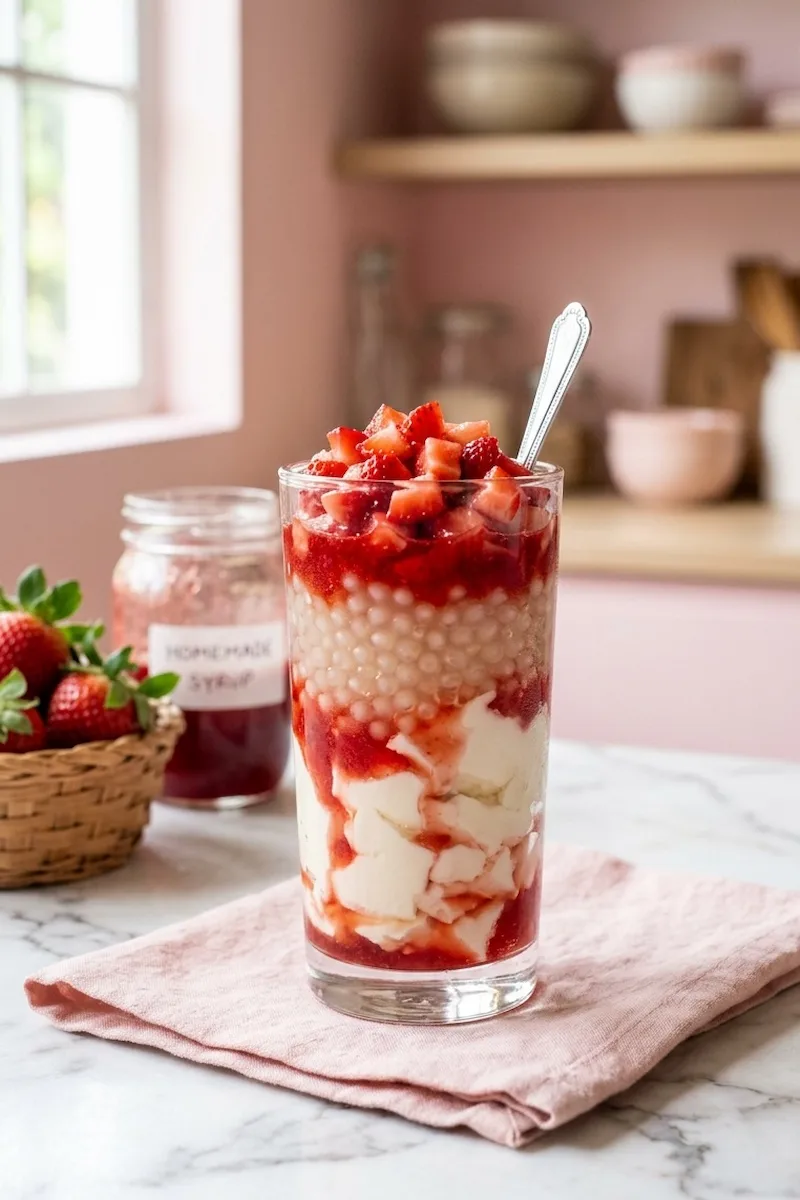
Strawberry taho is one of those regional Filipino specialties that most people outside the Philippines do not know exists and that most Filipinos who have visited Baguio City remember with disproportionate fondness. The classic taho sold by vendors in Manila and the lowlands uses arnibal, a warm brown sugar syrup, poured over silken tofu and tapioca pearls. In Baguio, in the cool highlands of the Cordillera mountain range where strawberries grow in abundance, the syrup becomes fresh strawberry, and the whole character of the dish shifts.
This homemade strawberry taho recipe recreates that Baguio experience in 15 minutes. It uses the same silken tofu and tapioca pearls as the classic version but replaces the arnibal with a fresh strawberry syrup (either homemade from scratch or using a leftover batch from the refrigerator). The result is warmer, fruitier, and more vivid than the traditional version, with a ruby-red color that makes it look more like dessert than breakfast, while being nutritionally more substantive than most breakfast options.
The recipe here includes the full technique for all three components, the Baguio cultural context that makes this version of taho distinct, five variations including a strawberry-ube fusion and a strawberry-matcha fusion, and practical answers to every question a first-time maker is likely to have.
Table of Contents
Quick Answer: The Perfect Strawberry Taho
🍓 At a Glance: Strawberry Taho
What Is Strawberry Taho? The Modern Twist on a Classic
The Traditional Taho Legacy
Taho (pronounced TAH-ho) is a warm Filipino street food made from fresh silken tofu, arnibal (brown sugar or muscovado syrup, sometimes infused with pandan leaf), and sago (small tapioca pearls). Vendors called magtataho carry the preparation in large aluminum containers suspended from a shoulder pole, walking through residential neighborhoods each morning, calling “TAHO!” to announce their presence. It is among the most recognizable and beloved sounds of a Filipino morning.
The dish has Chinese origins in douhua, a silken tofu dessert brought by early Chinese immigrant communities to the Philippines, and evolved into something distinctly Filipino: served warm, sweetened with local brown sugar, and culturally embedded in morning neighborhood life in a way that has lasted for generations. Our full exploration of the taho tradition, including the ube variation that started the modern taho evolution, is in our ube taho recipe.
Why Swap Brown Sugar Arnibal for Strawberry?
The arnibal of classic taho is genuinely delicious: warm, caramel-sweet, and deeply comforting. But it is one-dimensional in flavor. Strawberry syrup introduces something arnibal cannot: freshness. The bright, slightly acidic quality of strawberry, with its vitamin C and fruit sugars, contrasts with the neutral creaminess of the silken tofu in a way that feels lighter and more awakening than the purely sweet arnibal version.
There is also a color difference that matters considerably for appeal and for the antioxidant profile. Strawberry’s red pigment comes primarily from pelargonidin, an anthocyanin (the same class of polyphenol found in blueberries, red cabbage, and ube) that provides genuine antioxidant and anti-inflammatory activity. Arnibal, being caramelized sugar, provides essentially no phytonutrient content. Homemade strawberry syrup also eliminates the artificial Red Dye #40 found in commercial strawberry syrups, replacing a synthetic colorant with a natural one.
The Baguio Connection: Why Strawberry Taho Is a Northern Luzon Specialty
Baguio City: The Strawberry Capital of the Philippines
Baguio City sits at approximately 1,500 metres (nearly 5,000 feet) above sea level in the Cordillera mountain range of Northern Luzon. The elevation produces a climate unlike anywhere else in the Philippines: cool, often foggy mornings with daytime temperatures typically between 15 and 23 degrees Celsius (59 to 73 degrees Fahrenheit) even during months when the lowlands are intensely hot. This climate is what makes strawberry cultivation possible in a tropical country.
The municipality of La Trinidad in Benguet province, just north of Baguio City, is the center of Philippine strawberry production. La Trinidad’s strawberry farms occupy the valley floors and terraced hillsides of the Cordillera and produce the majority of fresh strawberries available in the Philippines. The combination of cool temperatures, well-drained volcanic soil, and regular highland rainfall creates ideal conditions for Fragaria x ananassa cultivation. Philippine strawberries from La Trinidad tend to be smaller, more intensely flavored, and more acidic than the large commercial varieties common in North America and Europe, which makes them particularly well-suited to syrups where concentrated flavor is the goal.
From Street Food to Highland Specialty
Classic taho with arnibal is primarily a Manila and lowland Philippine phenomenon. The brown sugar syrup and silken tofu combination has been sold by magtataho vendors in urban and suburban communities for over a century. In Baguio, the same vendor format exists, but the abundance of fresh strawberries from nearby La Trinidad created a local evolution: vendors began offering strawberry syrup instead of arnibal, sometimes supplementing the syrup with actual diced fresh strawberries in the cup.
For Filipinos who have visited Baguio, the memory of drinking warm strawberry taho on a cool highland morning, often bought from a vendor along Session Road or near the Baguio Public Market, is as specific and vivid as the memory of the city’s flower festival or the smell of pine trees in the morning fog. It is the kind of sensory food memory that turns a regional specialty into a nostalgic touchstone. Recreating it at home produces that specific quality: something that is simple in composition but specific in the feelings it evokes.
Fresh Strawberry Chunks vs Syrup: The Authentic Baguio Approach
Baguio street vendors use both approaches, sometimes simultaneously. Some vendors prepare a straightforward strawberry syrup, similar to the homemade version in this article, and pour it over the taho. Others, particularly those operating during peak strawberry season (roughly November through April), add actual diced fresh strawberries to the cup alongside the syrup, creating a version with both the pourable liquid syrup and the textural presence of real fruit chunks. This dual approach is what makes the Baguio version feel most abundant and genuinely fruit-forward.
To replicate the most authentic Baguio-style strawberry taho at home: prepare the strawberry syrup as described below, and additionally dice two to three fresh strawberries per serving into small cubes (approximately 5 mm). Add the diced strawberries to the assembled bowl just before serving the syrup, so they sit on top of the tapioca pearls and beneath the final pour of syrup. The syrup soaks slightly into the fresh fruit while the chunks provide a different textural element from the pearls and tofu.
🏔️ Travel Note for Baguio Visitors
The best time to experience authentic Baguio strawberry taho is during strawberry season (November to April), when La Trinidad farms are at peak production and vendors along Session Road and near the Baguio Public Market typically operate between 6 and 9 AM.
💡 Pro tip: Bring cash (small bills) for street vendors, and arrive early (before 8 AM) for the freshest taho and to avoid the tourist crowds!
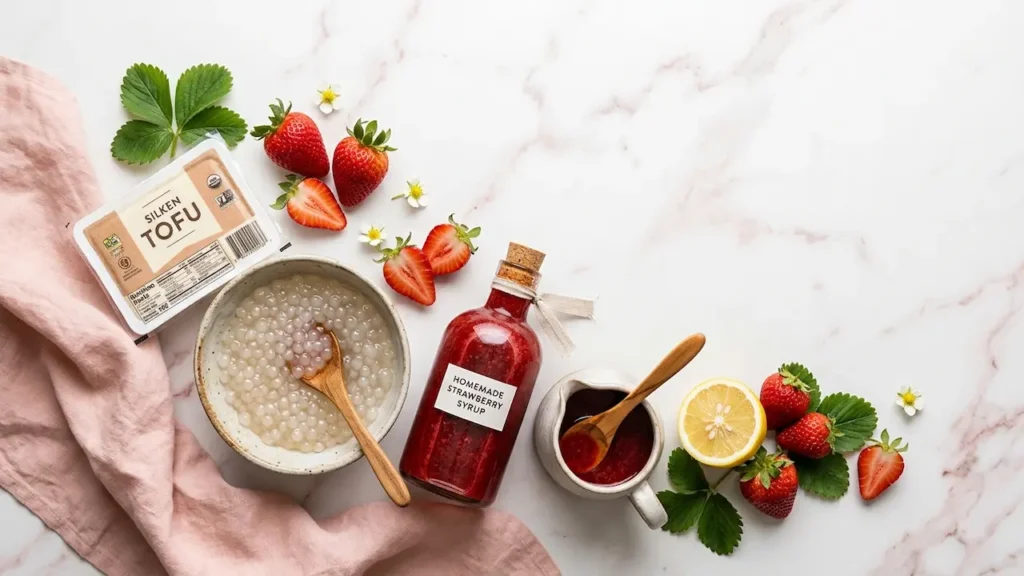
The 3 Core Components: Ingredient Stack
1. Silken Tofu: The Canvas
Silken tofu is the non-negotiable foundation of any taho. It cannot be substituted with firm, extra-firm, or any other tofu category. The entire textural experience of taho, the way it melts against the warmth of the syrup and yields to the spoon in smooth, flowing scoops, depends on the custard-like, gel-set structure that only silken tofu has. Firm tofu, pressed and drained of moisture, has a completely different structure: dense, slightly springy, and meaty. It is excellent for stir-fries and grilling; it is wrong for taho.
Quality differences between silken tofu brands are meaningful. Japanese-produced silken tofu (Morinaga is the most widely distributed) or tofu from Japanese-style producers tends to be smoother, more uniform in set, and more forgiving when warmed than budget domestic alternatives. The package liquid (soy water) in which silken tofu is packed should be clear to pale yellow; cloudy or pinkish liquid suggests the tofu is older or has been stored improperly.
To warm silken tofu without breaking it: place the whole block in a shallow bowl and set it in a larger pan of hot (not simmering) water for 5 minutes. The water bath warms the tofu through without creating hot spots or causing the outer surface to tighten. Alternatively, microwave the whole block at 50% power for 30 seconds: the reduced power prevents the steam buildup that causes silken tofu to pop and fracture. Never microwave at full power, and never stir or agitate the block while warming.
2. Tapioca Pearls (Sago): The Chew
Small sago pearls (3 to 4 mm diameter, the size of slightly enlarged pinheads) are the correct choice for taho. Large bubble tea tapioca pearls (8 to 12 mm) require 30 to 45 minutes of cooking, produce a different texture, and are associated with a different drink format. Small sago pearls cook in 10 to 15 minutes and have the delicate, translucent, gently chewy quality that is specific to taho and cannot be replicated by large pearls.
The cooking method: bring at least 1 litre of water to a full rolling boil before adding the pearls. This volume of water prevents the pearls from crowding and sticking to each other. Add the pearls to actively boiling water and stir immediately. Cook at medium-high heat, stirring every 2 minutes, for 10 to 12 minutes for small pearls. They are ready when mostly translucent with a tiny white center dot remaining. Remove from heat, cover, and let steam for 5 minutes off heat: this finish step cooks the center without mushifying the exterior. Drain and rinse briefly with warm (not cold) water. Toss with half a teaspoon of honey or simple syrup to prevent sticking.
3. Homemade Strawberry Syrup: The Star
The strawberry syrup is what defines this version of taho and distinguishes it from every other taho variation. A good strawberry syrup is deeply red, clearly fruity in flavor, gently sweet with a bright acidic edge from lemon juice, and pourable at warm or room temperature. A poor one tastes of sugar first and strawberry second, browning within days and lacking the vivid color that makes the dish visually striking.
Commercial strawberry syrups, including those marketed specifically for beverages and desserts, typically use artificial strawberry flavoring, Red Dye #40, and high-fructose corn syrup as their primary functional ingredients. The flavor approximates strawberry candy rather than fresh fruit. For Baguio-style strawberry taho to taste the way it does in Baguio, the syrup must be made from real strawberries.
Our complete strawberry syrup recipe covers three methods: the classic 15-minute stovetop approach for the best flavor and longest shelf life, a 5-minute no-cook blended version for immediate use, and a sugar-free version using natural sweeteners. If you have a batch already in the refrigerator, it keeps for 2 to 3 weeks and is ready to use immediately. If making fresh, start with the syrup first since it needs to cool slightly before assembly.
Step-by-Step Assembly: The Layering Technique
The assembly sequence matters for both aesthetics and for the eating experience. Layer in this order, into a clear glass or cup where the layers are visible from the side:
- Cook the sago pearls. As described above: rolling boil, 10 to 12 minutes stirring every 2 minutes, covered rest 5 minutes off heat. Drain, rinse with warm water, toss with a small amount of sweetener to prevent sticking. Keep warm.
- Warm the silken tofu. Place the block in a shallow bowl in a water bath of hot water for 5 minutes, or microwave at 50% power for 30 seconds. Handle with care; the block breaks easily once warm.
- Prepare or retrieve the strawberry syrup. If making fresh, use the quick stovetop or no-cook method. If using a refrigerated batch, warm it gently in a small saucepan over low heat with a splash of water if it has thickened. It should be pourable and warm, not cold and thick.
- Scoop the tofu. Using a wide, shallow spoon, scoop 2 to 3 portions of warm silken tofu into each serving cup or bowl. Use smooth, flowing scooping motions rather than pressing straight down: this produces the characteristic irregular, silky portions of authentic taho rather than dense cubes. Fill each cup roughly halfway.
- Add the sago pearls. Spoon 1 to 2 tablespoons of warm tapioca pearls over the tofu in each cup.
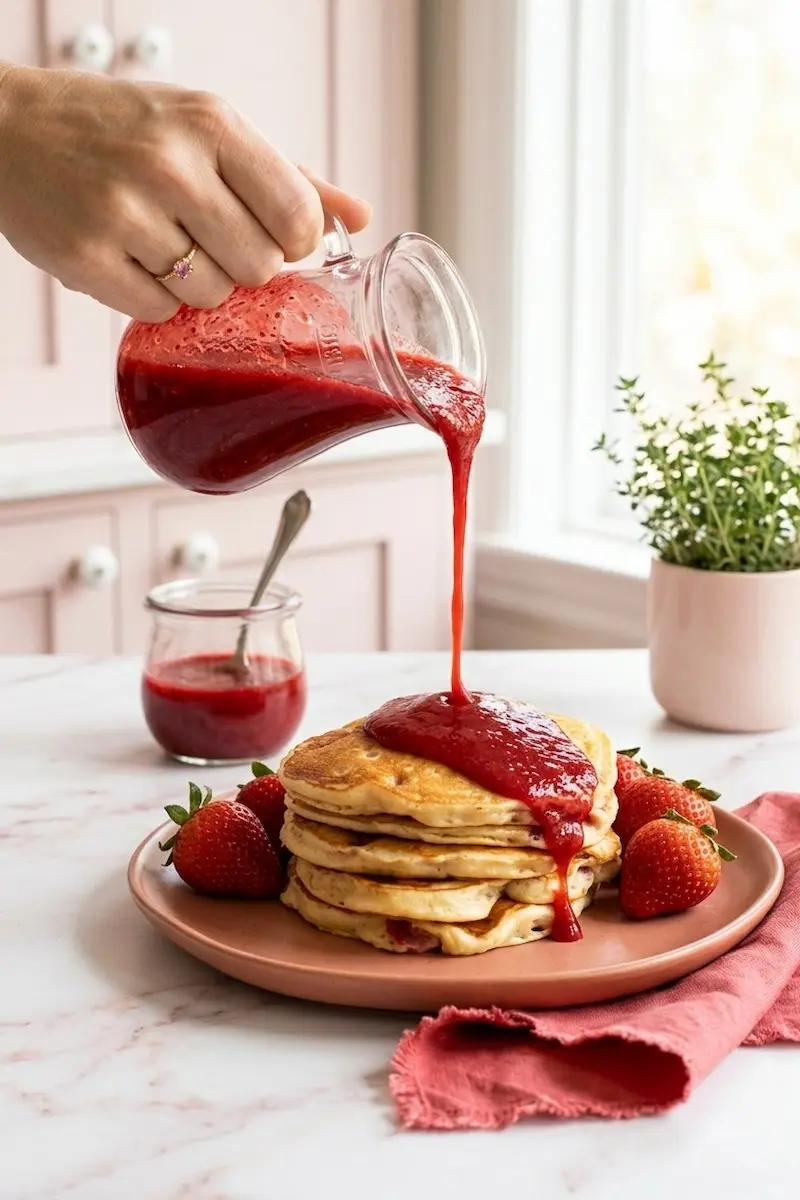
- Pour the strawberry syrup. Pour 2 to 3 tablespoons of warm strawberry syrup over each cup, letting it settle through the pearls and onto the tofu. The syrup will pool at the base and along the sides, creating visible red streaks in the tofu.
- Garnish and serve. For Baguio style: add 3 to 4 freshly diced strawberry pieces on top of each cup. Serve immediately while warm.
Strawberry Taho
Warm silken tofu topped with chewy tapioca pearls and vibrant homemade strawberry syrup, inspired by the famous strawberry taho of Baguio City. Ready in 15 minutes, naturally vegan, dairy-free, and gluten-free. A fruity Filipino breakfast, snack, or dessert.
- Prep Time: 5 minutes
- Cook Time: 10 minutes
- Total Time: 15 minutes
- Yield: 4 servings 1x
- Category: Breakfast
- Method: Stovetop
- Cuisine: Filipino
- Diet: Gluten Free
Ingredients
- 400 g silken tofu (1 block, Japanese-style preferred)
- 80 g (1/2 cup dry) small tapioca pearls (sago)
- 8 to 12 tablespoons homemade strawberry syrup
- 8 to 12 fresh strawberries, diced small (optional)
- 1 litre water (for cooking sago)
- 1/2 teaspoon honey or simple syrup (to prevent sticking)
- 300 g fresh or frozen strawberries (for syrup)
- 200 g (1 cup) sugar (for syrup)
- 240 ml (1 cup) water (for syrup)
- 1 tablespoon fresh lemon juice (for syrup)
Instructions
- Bring 1 liter of water to a rolling boil.
- Add the sago pearls and stir immediately.
- Cook for 10 to 12 minutes, stirring every 2 minutes.
- Remove from heat, cover, and let rest for 5 minutes.
- Drain the sago, rinse with warm water, and toss with honey or simple syrup.
- Place the silken tofu block in hot water for 5 minutes, or microwave at 50% power for 30 seconds.
- Prepare the strawberry syrup by combining strawberries, sugar, water, and lemon juice in a saucepan.
- Simmer for 8 to 10 minutes until strawberries soften completely.
- Blend or strain the syrup if desired and keep warm.
- Dice fresh strawberries for garnish if using.
- Scoop warm silken tofu into 4 serving cups.
- Add 1 to 2 tablespoons of sago pearls to each serving.
- Pour 2 to 3 tablespoons of warm strawberry syrup over each cup.
- Top with diced strawberries.
- Serve immediately while warm.
Notes
- Inspired by the famous strawberry taho sold in Baguio City, Philippines.
- Homemade strawberry syrup delivers the freshest flavor and color.
- Sago pearls harden after refrigeration; use within 24 hours.
- Store cooked sago in simple syrup if preparing ahead.
- Best served immediately after assembly.
- Silken tofu absorbs syrup quickly and softens after 30 minutes.
- For a lighter version, reduce the syrup quantity.
- For extra texture, add additional diced strawberries before serving.
- Naturally vegan when using simple syrup instead of honey.
- Gluten-free and dairy-free as written.
Nutrition
- Serving Size: 1 serving
- Calories: 180
- Sugar: 20g
- Sodium: 15mg
- Fat: 3g
- Saturated Fat: 0g
- Unsaturated Fat: 2g
- Trans Fat: 0g
- Carbohydrates: 34g
- Fiber: 2g
- Protein: 6g
- Cholesterol: 0mg
Delicious Strawberry Taho Variations
Classic Strawberry Taho (Traditional Baguio Style)
The recipe above is the authentic Baguio-style version when made with fresh diced strawberry garnish alongside the syrup. Silken tofu, sago pearls, homemade strawberry syrup, and fresh strawberry chunks on top. Served warm. This is the version that Baguio vendors serve during peak strawberry season, and it is the version that produces the most nostalgic response from Filipinos who grew up making the trip to the highlands.
The Ultimate Fusion: Strawberry-Ube Taho
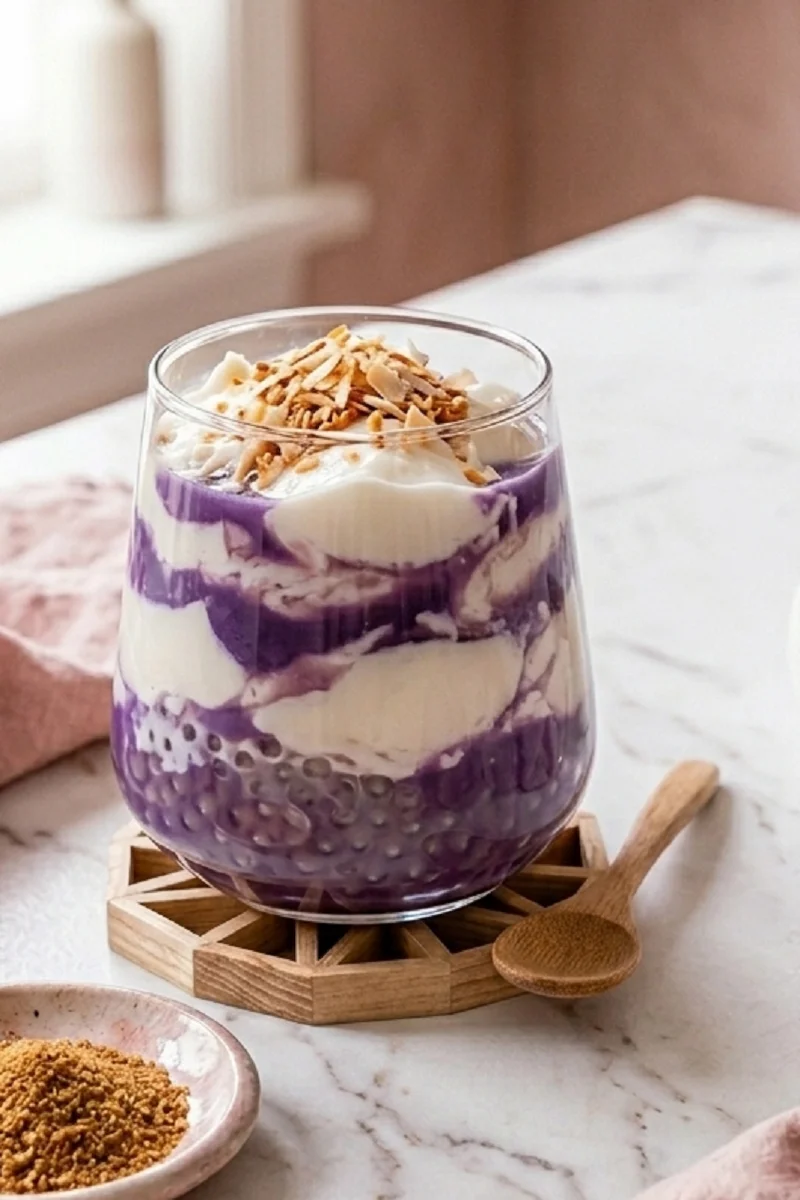
This is the most visually dramatic variation and the one most likely to generate conversation at a gathering. Prepare both homemade strawberry syrup and warmed, thinned ube syrup (ube halaya loosened with coconut milk over low heat until pourable). Pour the ube syrup first, around the edges of the cup, and then pour the strawberry syrup in the center. The red and purple syrups contrast against the white tofu and translucent pearls to produce a genuinely striking visual that still tastes like a coherent combination: the fruity brightness of strawberry against the earthy nuttiness of ube creates a more complex flavor than either alone.
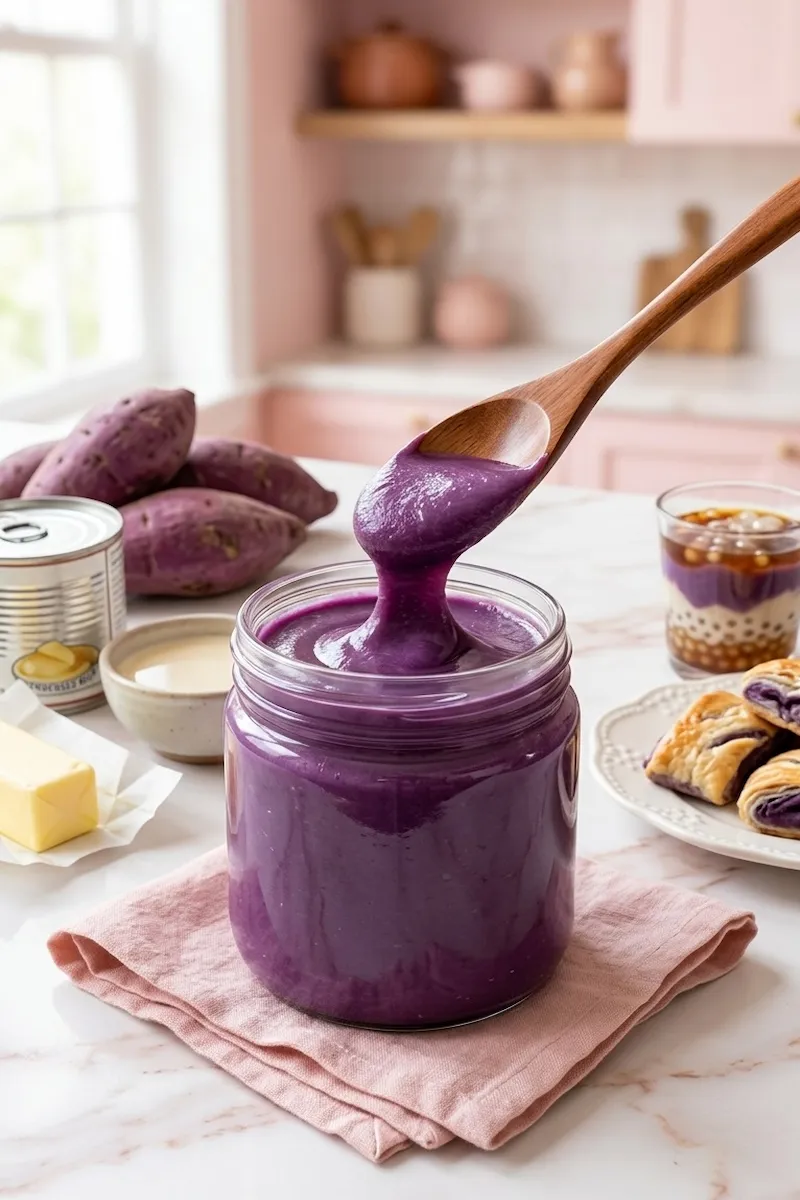
Our complete ube halaya recipe covers three methods for making the purple yam jam base, including a quick 5-minute no-cook version that can be made alongside the strawberry syrup for same-session preparation of the fusion version.
🎨 Fusion Tip: Perfect Strawberry-Ube Color Separation
For the cleanest color separation in the strawberry-ube fusion taho, use the temperature-density technique to keep the two syrups visually distinct:
💡 Pro trick: For even more dramatic contrast, layer the ube on the bottom and the strawberry on top—the natural density of the thicker ube base will act as a stable foundation for the lighter strawberry syrup to float above.
Iced Strawberry Taho (Summer Version)
When Baguio’s cool climate is not available to you and the temperature is firmly in the “too hot for warm desserts” range, the iced version is the solution. Chill all components separately: refrigerate the cooked sago pearls in simple syrup, keep the strawberry syrup cold, and refrigerate the silken tofu in its packaging. To serve, fill a glass halfway with crushed ice, then layer cold tofu (scooped from the cold block), cold sago pearls, and cold strawberry syrup. The syrup soaks into the ice slightly, and the whole thing has the quality of a strawberry slushie crossed with a creamy dessert. Fresh diced strawberries on top complete the summer aesthetic.
Protein-Packed Strawberry Taho
For a post-workout version or a more substantial breakfast, add one scoop of unflavored or vanilla protein powder (whey, pea, or collagen peptides) to the warm silken tofu before scooping. Stir the powder gently through the tofu while it is warm, working carefully to avoid breaking the block into pieces. The protein integrates into the tofu and increases the protein content from approximately 5 to 6 grams per serving to 20 to 25 grams. The texture changes slightly (less purely silky, very slightly denser), but the overall experience is still recognizably taho. Collagen peptides are the most invisible option: they dissolve without affecting texture or flavor.
This version pairs well with our Mark Hyman snack ideas guide for building a full morning routine around balanced, protein-forward food choices.
Strawberry-Matcha Taho (Red and Green Fusion)
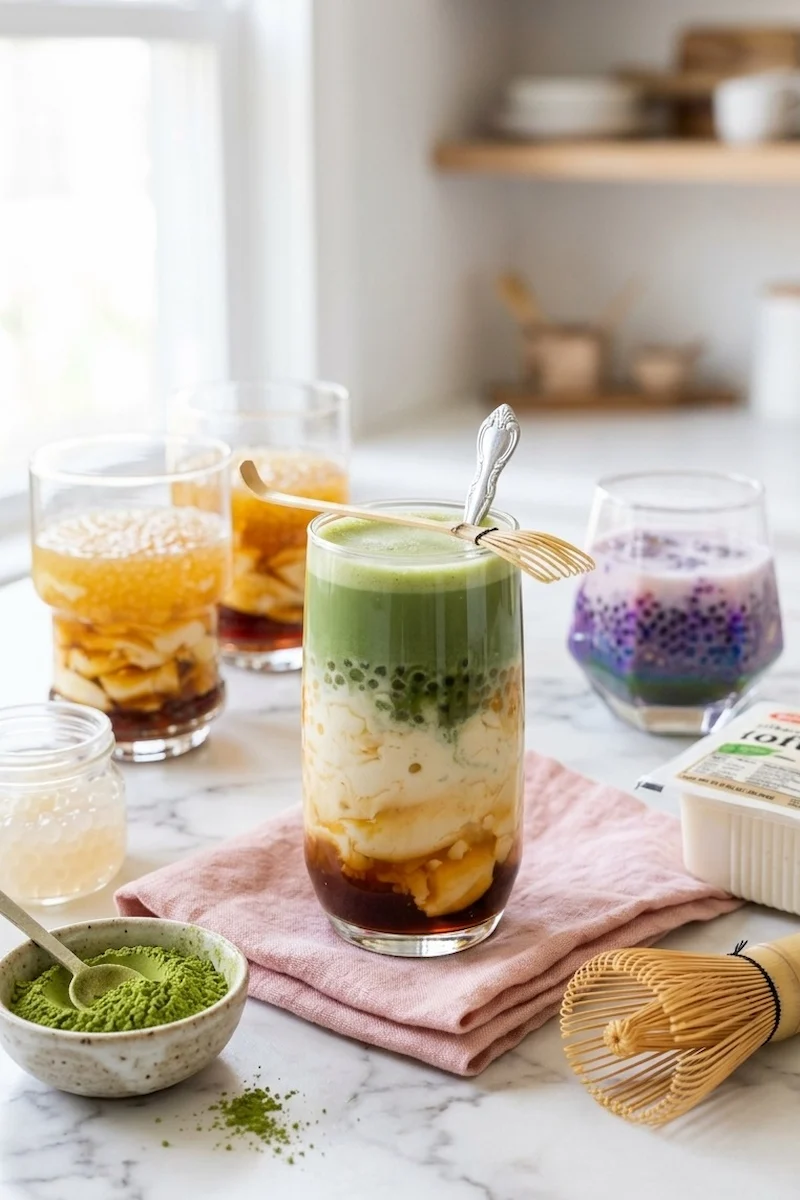
The color story of strawberry-matcha taho is perhaps the most visually striking of any taho variation: vivid red strawberry syrup and vibrant green matcha syrup layered over white tofu and translucent pearls produce a combination that photographs dramatically and tastes genuinely interesting. The bright fruitiness of strawberry and the earthy, slightly bitter quality of matcha are contrasting enough to be intriguing rather than harmonious, which is what makes this version most appropriate as a special-occasion or party preparation rather than an everyday breakfast.
Prepare the matcha syrup as described in our matcha taho recipe: sift 2 teaspoons of culinary-grade matcha into 80 ml of water at 80°C (175°F), whisk until smooth, and sweeten with one tablespoon of honey or maple syrup. Pour the matcha syrup over one side of the assembled taho cup and the strawberry syrup over the other. The two syrups will blend slightly at the edges, creating a transitional orange-red zone that is also beautiful.
The Nutritional Benefits of Strawberry Taho
Plant-Based Protein and Isoflavones from Silken Tofu
Silken tofu contributes 5 to 6 grams of complete protein per 100-gram serving, providing all nine essential amino acids in meaningful amounts. For a breakfast or snack food, this is nutritionally unusual: most sweet morning foods (fruit, pastries, sweetened yogurt) provide minimal protein. The protein from tofu supports satiety and slows glucose absorption from the carbohydrates in the syrup and tapioca pearls, moderating the postprandial blood sugar response.
Silken tofu also provides isoflavones (genistein and daidzein), plant compounds with weak estrogenic activity that have been studied for their role in supporting hormonal balance, particularly around menopause, and for their potential in reducing the risk of hormone-sensitive conditions. The evidence is mixed and context-dependent, but the isoflavone content adds a nutritional dimension that most other sweet snack foods lack entirely.
Anthocyanins and Vitamin C from Strawberries
Strawberries contain pelargonidin-3-glucoside as their primary anthocyanin, the compound responsible for their vivid red color. Pelargonidin belongs to the same anthocyanin family as the cyanidin and delphinidin found in blueberries, acai, and ube and shares their documented antioxidant and anti-inflammatory properties. In a homemade strawberry syrup made with real fruit and minimal heat exposure, a meaningful amount of this compound is retained (more heat-stable than some other anthocyanins, but still degraded by prolonged cooking).
Strawberries are also among the richest whole-food sources of vitamin C available: 100 grams of fresh strawberries provides approximately 58 mg of vitamin C, roughly 65% of the daily recommended intake. Some of this is retained in syrup form despite the cooking process, particularly when lemon juice (itself a vitamin C source) is added off-heat. Vitamin C supports immune function and collagen synthesis and acts as a co-antioxidant that recycles vitamin E. Our purple peel weight loss guide covers the broader science of red and purple fruit pigments, including the pelargonidin found in strawberries alongside the better-studied cyanidin and delphinidin of darker berries.
Lower Sugar Impact Than Commercial Taho Variants
Classic arnibal taho uses a generous amount of brown sugar in its syrup, typically producing 15 to 25 grams of added sugar per serving depending on the vendor. Commercial bottled strawberry syrups used in some prepared taho products can be even higher, with additional high-fructose corn syrup contributing more rapidly absorbed glucose. Homemade strawberry taho using a homemade syrup where you control the sugar content can be made with significantly less: a syrup using 50% of the standard sugar amount still tastes complete because the natural fruit sugars and the tartness of the strawberry provide flavor complexity that arnibal, being purely caramelized sugar, does not.
Our flat belly blueberry smoothie guide covers the blood sugar dimension of fruit-based breakfasts in more detail.
Frequently Asked Questions About Strawberry Taho
Why is strawberry taho famous in Baguio?
Baguio City’s elevation (approximately 1,500 metres above sea level) creates a cool, temperate climate that is unique in the Philippine context and that happens to be ideal for strawberry cultivation. The nearby municipality of La Trinidad in Benguet province is often called the Strawberry Bowl of the Philippines, producing the majority of the country’s fresh strawberry supply from farms that have operated for decades. With fresh strawberries abundant and affordable throughout the November to April growing season, Baguio vendors adapted the traditional taho format to use what was locally available and exceptional. The result became so associated with the Baguio travel experience that returning Filipinos consistently cite it as one of their clearest food memories of the city.
Can I make authentic Baguio-style strawberry taho at home?
Yes, and you can get quite close to the authentic experience with a few specific choices. Use fresh or high-quality frozen strawberries for the syrup rather than any commercial strawberry syrup. Make the syrup with fresh lemon juice to get the bright acidity that distinguishes real fruit-based syrup from the candy-sweet commercial versions. Add fresh diced strawberry pieces on top of each assembled cup to replicate the chunk texture that Baguio vendors who use real fruit include. Serve warm, not cold, because authentic taho in Baguio (like in Manila) is a warm food eaten on cool mornings. The result will not be identical to the version from a vendor on Session Road, but it will be recognizably and genuinely strawberry taho.
Can I use store-bought strawberry syrup for this recipe?
You can, with significant caveats. Commercial strawberry syrups, including most cafe and beverage syrups, use artificial strawberry flavoring, Red Dye #40 (a synthetic colorant), and high-fructose corn syrup as their primary ingredients. The flavor is closer to strawberry candy than fresh fruit. The color is brighter and more artificial-looking than natural strawberry red. For a taho that captures the Baguio spirit of genuine, locally grown fresh fruit as the star ingredient, commercial syrup is a meaningful step down. Our homemade strawberry syrup takes 15 minutes using the quick stovetop method and keeps refrigerated for 2 to 3 weeks, making it practical enough to keep a batch on hand for multiple uses.
Is strawberry taho healthy for children?
Strawberry taho made with homemade syrup is one of the more nutritionally complete sweet foods children are likely to willingly eat. The silken tofu provides 5 to 6 grams of complete plant protein per serving, meaningful calcium (approximately 8% of the daily requirement), and iron. The strawberry syrup provides vitamin C and anthocyanin antioxidants. The tapioca pearls provide easily digestible carbohydrate energy. There is no artificial dye, no artificial flavoring, and no high-fructose corn syrup when made homemade. The fact that it looks like a dessert and tastes decidedly sweet means most children who are resistant to tofu in other forms will accept it readily in taho format. The sugar content (from the syrup) is the primary nutritional consideration; using a reduced-sugar syrup version works well for children.
How do I keep the tapioca pearls from getting hard?
Tapioca pearls harden as they cool and lose moisture, and this process accelerates significantly in the refrigerator. The most effective prevention: cook the pearls to full translucency (with the 5-minute covered rest after cooking), rinse briefly with warm water, then immediately toss them with a small amount of simple syrup or honey while still warm. The coating of syrup slows the moisture loss that causes hardening. If making ahead, store the cooked pearls fully submerged in simple syrup (equal parts water and sugar, dissolved and cooled) in a sealed container at room temperature for up to 6 hours or refrigerated for up to 24 hours. To restore pearls that have hardened, place them in a small saucepan with a few tablespoons of water over low heat and stir gently for 2 to 3 minutes until they soften again.
Can I make strawberry taho ahead of time?
The components store separately well; the assembled version does not. Silken tofu in its sealed, unopened packaging keeps in the refrigerator for several days past its purchase date; once opened, keep in cold water in a sealed container and use within 2 days, changing the water daily. Homemade strawberry syrup keeps refrigerated for 2 to 3 weeks. Cooked sago pearls keep for up to 24 hours at room temperature in simple syrup or 24 hours refrigerated, after which they harden irreversibly. For a gathering, the practical approach: prepare the syrup the day before (it is actually better after 24 hours of refrigeration as the flavor deepens), cook the pearls the morning of serving, and warm the tofu immediately before assembly. The assembled taho should be served within 10 to 15 minutes: the syrup permeates and softens the tofu quite quickly, and the visual separation between layers disappears within 30 minutes.
Common Mistakes That Ruin Strawberry Taho
Using Firm or Extra-Firm Tofu
This mistake fundamentally changes the dish. Firm tofu, even cut into small cubes and warmed, has a dense, slightly rubbery texture that is the opposite of what taho requires. The entire appeal of taho is the way the silken tofu yields in the spoon and melts against the warmth of the syrup. Firm tofu does not do this. There is no technique that converts firm tofu into the taho experience; only silken tofu produces it. If the only tofu available is firm, make a different dish. Silken tofu is available at most well-stocked grocery stores in the refrigerated section and at virtually all Asian grocery stores.
Overcooking the Sago Pearls
The common error with sago pearls in any taho is staying at the stove too long. Overcooked pearls lose their gentle chew and collapse into a starchy paste that neither looks nor feels right against the smooth tofu. The timing window is narrow for small pearls: 10 to 12 minutes of active cooking at a rolling boil, followed by 5 minutes of covered steam-finishing off the heat.
Test at the 10-minute mark by removing a pearl and biting it in half: the outer layer should be fully translucent and soft, with only a very small white center dot remaining. The covered rest completes the center. Drain immediately after the 5-minute rest; do not allow the pearls to sit in hot water beyond this point.
Serving Cold Tofu
Taho is fundamentally a warm food. The warmth of the silken tofu is part of what makes it feel comforting and distinct from other silken tofu preparations. Cold tofu straight from the refrigerator has a slightly firmer, less yielding texture and lacks the gentle warmth that makes the syrup meld with the tofu surface rather than sitting on top of it. Always warm the tofu before serving, either with the water bath method or the 50% power microwave method. This takes 5 minutes and is not optional for authentic taho texture.
Using Commercial Strawberry Syrup
The syrup is the most prominent flavor in the dish. A taho made with a commercial strawberry syrup containing artificial flavoring and Red Dye #40 will taste like candy, not like Baguio strawberries. The effort to make a homemade strawberry syrup (15 minutes, four ingredients) is worth it every time because the flavor difference is not subtle: real strawberry syrup has brightness, slight acidity, and genuine fruit complexity that artificial syrup cannot replicate. Keep a batch in the refrigerator, and the question of which to use answers itself.
Conclusion: A Bright Start to Your Morning
Strawberry taho is one of the most joyful things you can make in a home kitchen in 15 minutes. It is warm, it is vivid, it is nutritionally more substantive than it looks, and it carries the specific cultural weight of a place: Baguio City, cool mornings, strawberry farms terraced into Cordillera hillsides, and vendors calling from the street below.
The recipe itself is three components that are individually simple and collectively produce something that feels special. Master the silken tofu warming technique. Nail the sago pearl timing with the covered rest. Use a real homemade strawberry syrup. These three things, done correctly, produce a Filipino strawberry dessert that rivals anything sold on Session Road.
Try the classic version first, with fresh diced strawberry chunks on top. Once that is comfortable, the strawberry-ube fusion and strawberry-matcha variations are the natural next experiments. Both are visually extraordinary and take only the addition of a second syrup to achieve.
📖 Related Reading: Your Taho & Syrup Toolkit
Explore homemade syrups, taho variations, and balanced meal ideas
🇵 More Filipino recipes and food traditions at JoyfulBiteRecipes.com