
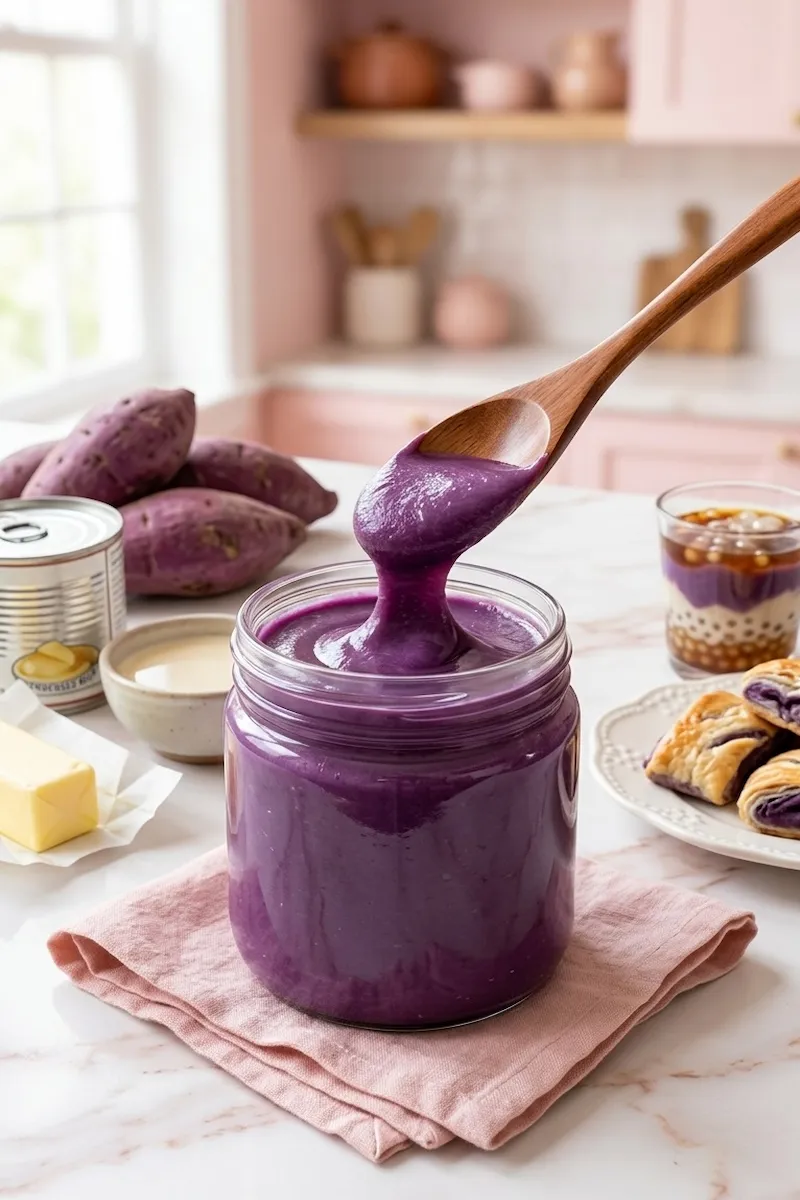
Ube halaya is the foundation of Filipino ube desserts. It is the deep purple jam that turns a plain cheesecake into something extraordinary, fills donuts with color and flavor, gives taho its beautiful ube syrup, layers through banana pudding in vivid purple ribbons, and spread on warm pandesal on a weekday morning is a small daily luxury that requires almost no effort once you have a jar in the refrigerator.
Making homemade ube halaya gives you control over everything the store-bought version does not: the sweetness level, the consistency, the intensity of the ube flavor, and the absence of artificial coloring and preservatives. More importantly, the difference in flavor between a freshly made ube halaya from real purple yam and a commercially produced version is immediately noticeable to anyone who has tasted both. The fresh version has a depth and earthiness that processing and shelf-stabilization remove.
This guide covers three complete methods for making this purple yam jam recipe at home, from the traditional 45-minute stovetop method that produces the best flavor to a 20-minute Instant Pot version and a 5-minute no-cook approach for small batches. Every step of the stovetop ube halaya recipe is explained in detail, including the specific visual and textural cues that tell you the jam has reached the right consistency. Storage guidance, troubleshooting, and the full range of uses for homemade ube halaya follow the recipes.
Table of Contents
Quick Answer: The Perfect Ube Halaya
🟣 At a Glance: Ube Halaya
What Is Ube Halaya and Why Is It Essential?
The Filipino Purple Yam Jam Tradition
Ube halaya (also spelled “ube halaya” or written as “ube jam” in English) is a cooked jam made from purple yam (Dioscorea alata), condensed milk, and butter. The word “halaya” comes from the Spanish “jalea” (jelly or jam), a linguistic remnant of the Spanish colonial period in the Philippines. The preparation is distinctly Filipino: the technique of slowly cooking the yam with sweetened dairy while stirring continuously is a labor of patience that produces a jam unlike anything in Spanish or European preserving traditions.
Ube halaya is sold in glass jars at Filipino grocery stores and increasingly at Asian supermarkets, but its home production has always been considered a mark of care and skill in Filipino households. It is made for significant occasions: Christmas gatherings, fiestas, family reunions, and the kind of special merienda that signals someone has taken real time for the people they are feeding. A freshly made batch of ube halaya, still warm and fragrant in the pot, smells of cooked yam, sweet cream, and something warm and indefinable that is simply home cooking done well.
Ube Halaya vs Ube Extract vs Ube Powder
| Form | What It Is | Best For | Flavor Quality |
| Ube halaya (this recipe) | Cooked purple yam jam | Any application needing real Ube flavor and texture | Excellent: complex, earthy, authentic |
| Ube extract | Concentrated artificial/natural flavoring + dye | Color boost when halaya is unavailable; baked goods accent | Moderate: flavor present but thinner and synthetic |
| Ube powder | Dehydrated ube, sometimes with additives | Baking applications needing dry ingredients; smoothies | Good but one-dimensional; no fresh yam character |
| Fresh ube (cooked) | Steamed and mashed raw purple yam | The base for making halaya or savory applications | Best flavor complexity before adding dairy and sugar |
| Store-bought halaya | Commercial ube jam, pasteurized | Convenience when time is short | Good to decent; missing fresh ube depth and fragrance |
The hierarchy is straightforward: fresh ube cooked into homemade halaya is the best-tasting form. Store-bought halaya is a very acceptable substitute. Ube extract is useful for color and accent. Ube powder occupies a middle ground. For any recipe where ube is the primary flavor, homemade halaya or store-bought halaya are the only options that deliver the authentic experience.
Why Homemade Ube Halaya Beats Store-Bought
The flavor difference is the primary reason. Store-bought ube halaya is cooked at a commercial scale, pasteurized for shelf stability, and often contains stabilizers, artificial coloring (many commercial varieties are brighter purple than natural ube ever produces), and sweetness levels calibrated for mass appeal rather than for showcasing the ube itself. A homemade ube halaya recipe from fresh or frozen ube tastes unmistakably of purple yam in a way that even high-quality commercial products do not fully replicate.
The secondary reason is control. Sweetness is the most variable parameter in ube halaya: the natural sugar content of ube varies by variety and ripeness; the condensed milk adds significant sweetness; and personal preference for desserts varies considerably. A homemade Filipino ube jam lets you taste and adjust at each stage, producing a final product calibrated to your specific taste and to the specific recipe you intend to use it in. A very sweet halaya for spreading on plain toast is different from a moderately sweet halaya intended as a layer in a cream cake where other components add their own sweetness.
The Science of Perfect Ube Halaya
Understanding Ube’s Natural Properties
Ube (Dioscorea alata) is a starchy tuber with a moisture content that varies significantly by freshness and storage. Fresh ube that has been recently harvested is moister and more fragile; older ube or frozen grated ube has typically lost some moisture. This moisture variation is the primary reason ube halaya cooking times can differ between batches: a wetter ube requires more evaporation time to reach the right consistency, while a drier ube cooks down faster and requires more careful attention to avoid burning in the final stages.
The starch in ube gelatinizes during cooking, which is the primary thickening mechanism in ube halaya beyond the reduction of liquid from the dairy. Ube starch gelatinizes at approximately 65 to 75 degrees Celsius, well below the temperature of active cooking. This means the thickening begins early in the cooking process and continues as the moisture evaporates. The final jam thickness depends on how long the mixture is cooked and how much moisture is driven off.
The anthocyanins responsible for ube’s vivid purple color are water-soluble and moderately heat-sensitive. Prolonged cooking at high temperatures can shift the color from vivid purple toward a more gray-purple or brownish-purple tone. This is why traditional ube halaya is cooked over low to medium-low heat: preserving both the flavor complexity and the color. Adding a small amount of ube extract at the end of cooking (optional) is a practical way to restore any color lost during the cooking process without affecting flavor significantly. Our purple peel weight loss guide explores the broader science of anthocyanins and why these pigment compounds matter nutritionally.
The Role of Each Ingredient
Ube: The flavor, color, and textural base. Everything else in the recipe is a support ingredient.
Sweetened condensed milk: Provides both sweetness and creaminess in a single ingredient. The concentrated sugar in condensed milk also acts as a mild preservative, extending shelf life. Its thick, syrupy consistency contributes to the smooth, glossy texture of the final jam.
Unsalted butter: Adds richness, a glossy sheen, and a rounded flavor that balances the slight earthiness of the ube. Butter added at the beginning of cooking integrates into the jam structure; butter added off heat at the end produces a more pronounced gloss. Some recipes do both. Unsalted butter is essential: salted butter introduces salt at an uncontrolled level that can become pronounced as the jam reduces.
Evaporated milk (optional): Adds smoothness and reduces the overall sweetness slightly compared to using all condensed milk. If your ube halaya is tending sweet, substituting some of the condensed milk with evaporated milk and adding sugar to taste are good adjustment strategy.
Sugar (if using): Additional sugar beyond the condensed milk is needed only if the ube itself is not very sweet or if the recipe calls for a sweeter result. Taste before adding any additional sugar.
Vanilla extract: Optional but effective at amplifying the naturally vanilla-like notes in ube. Add off heat to prevent the volatile aromatic compounds from evaporating during cooking.
Achieving the Perfect Consistency
The target consistency for ube halaya depends on its intended use:
- For spreading (toast, pandesal, pancakes): thick enough to hold a small mound on a spoon but soft enough to spread easily at room temperature.
- For piping (filling donuts, pastries, cakes): thick enough to hold a clean pipe without collapsing, similar to a thick pastry cream. This requires cooking slightly longer than the spreading consistency.
- For layering (taho syrup, banana pudding): slightly looser than spreading consistency, pourable when warm but thick enough to coat when cold.
The most reliable test: draw a spatula through the jam in the pan. For spreading consistency, the line should fill back slowly over 3 to 4 seconds. For piping consistency, the line should hold clean for 5 or more seconds. For syrup consistency, the line fills back in 1 to 2 seconds. Remember that ube halaya thickens significantly as it cools; a jam that looks slightly loose at cooking temperature will often be exactly right when cold. Test a small spoonful on a cold plate if you are unsure.
The Best Ube Halaya Recipe: All 3 Methods
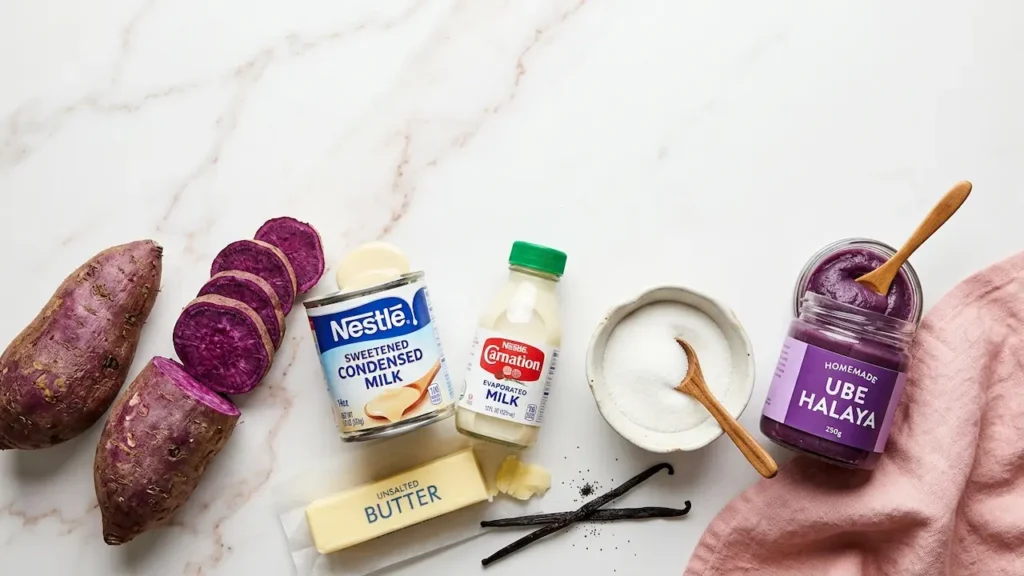
Ingredients (All Methods)
| Ingredient | Amount | Notes |
| Fresh ube or frozen grated ube | 900 g (2 lbs) fresh, or 4 cups frozen grated | Frozen grated ube is the most reliable home option, available at Filipino and Asian grocery stores |
| Sweetened condensed milk | 1 can (395 g / 14 oz) | Full-fat; do not substitute low-fat versions |
| Unsalted butter | 115 g (1/2 cup / 1 stick) | Cut into tablespoon-sized pieces for easier incorporation |
| Evaporated milk | 120 ml (1/2 cup) | Optional; reduces sweetness and adds smoothness |
| White sugar | 50 to 80 g (1/4 to 1/3 cup) | Optional; add only after tasting; may not be needed |
| Pure vanilla extract | 1 teaspoon | Add off heat only |
| Ube extract | 1/4 to 1/2 teaspoon | Optional; use only to restore color if needed after cooking |
🛒 Pro Tip: Sourcing Ube for Home Cooks
For home cooks outside the Philippines, the most practical choice is frozen grated ube. Here’s why:
💡 Where to find it: Filipino grocery stores, pan-Asian supermarkets (Seafood City, 99 Ranch), or online retailers like Weee! and Amazon. Look for brands like “Deep” or “Polynesian” for quality.
Method 1: Traditional Stovetop Ube Halaya (Best Flavor)
Total time: approximately 60 to 75 minutes. Active stirring time: 30 to 45 minutes.
This is the authentic method and produces the deepest, most complex ube halaya flavor. It requires patience and continuous attention during the final cooking phase, but the result is meaningfully better than the faster methods. Make this version when you have time and want to produce the best possible Filipino ube jam for a special occasion.
Step 1: Prepare the ube.
If using fresh ube: peel the ube and cut it into 2 to 3 cm chunks. Place in a steamer basket over boiling water and steam, covered, for 20 to 25 minutes until completely tender when pierced with a fork. Do not boil the ube directly in water; boiling leaches color and flavor compounds into the cooking water, which you then discard. Steaming preserves both. Transfer the steamed ube to a bowl and allow to cool for 10 minutes.
If using frozen grated ube: thaw completely at room temperature or overnight in the refrigerator. Steam the thawed grated ube in a steamer basket for 10 to 12 minutes until fully cooked through. Transfer to a bowl.
Step 2: Mash and smooth.
Mash the cooked ube with a potato masher until no large chunks remain. For the smoothest possible halaya, transfer the mashed ube to a blender or food processor with 2 to 3 tablespoons of the condensed milk and blend until completely smooth. The blender step is optional but produces a noticeably silkier final jam with no fibrous texture. Strain through a fine mesh strainer if you want maximum smoothness (also optional, but recommended for piping applications).
Step 3: Begin cooking.
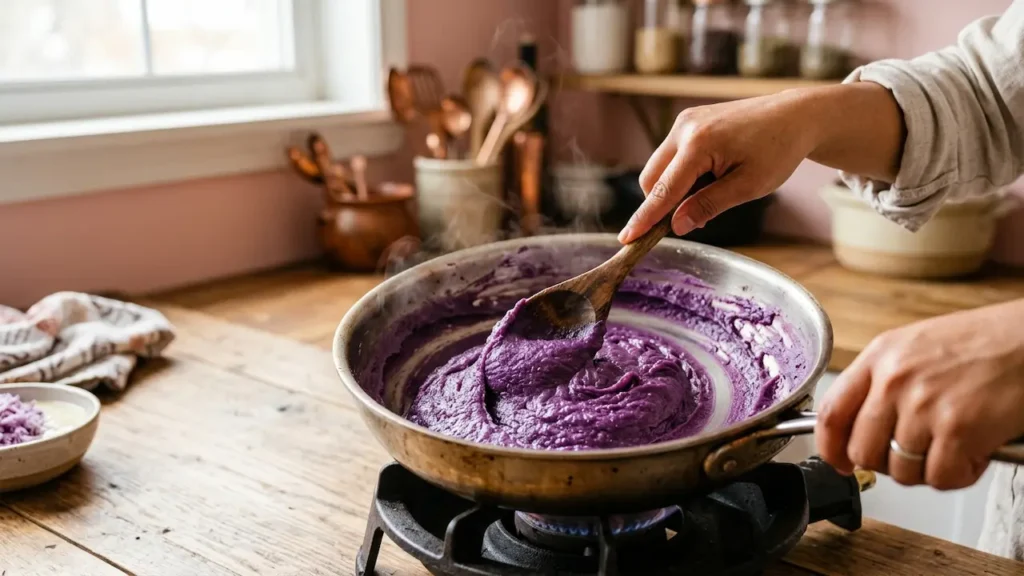
In a wide, heavy-bottomed pan (a wok or wide nonstick skillet works well; the wider surface area accelerates moisture evaporation), combine the smooth ube puree with the condensed milk and half the butter. Set over medium-low heat. Stir continuously with a flat-edged wooden spoon or heat-resistant silicone spatula, scraping the bottom and sides of the pan at every pass.
Step 4: Develop the jam.
The mixture will be quite loose for the first 10 minutes as the condensed milk heats and the residual moisture from the ube evaporates. Continue stirring continuously. After approximately 15 minutes, the mixture will begin to thicken visibly. Add the remaining butter in pieces, stirring each piece in fully before adding the next. If using evaporated milk, add it gradually in this phase, one tablespoon at a time, to maintain a smooth consistency.
The critical phase begins when the jam starts to pull away from the sides and bottom of the pan in a clean mass. This happens at approximately 25 to 35 minutes of cooking, and it is when the most attentive stirring is required. At this stage, the jam can scorch on the bottom in under 30 seconds if the spatula pauses. Keep the heat at medium-low and continue scraping the bottom of the pan constantly.
Step 5: Finish and jar.
Remove from heat when the jam reaches your target consistency (see the consistency guide in the science section above). Add the vanilla extract and stir well. Taste for sweetness and add additional sugar only if needed, stirring over low heat for 1 to 2 minutes to dissolve. Add ube extract if the color needs a boost. Transfer immediately to clean, warm glass jars while hot. Fill to within 1 cm of the rim. Allow to cool to room temperature before refrigerating.
🎨 Pro Tip: Preserving Vibrant Purple Color (Stovetop Method)
The most common color issue with stovetop ube halaya is a grayish-purple result instead of a vivid purple. Here’s the science and the fix:
💡 Visual cue: Perfect ube halaya should be a rich, jewel-toned purple—not gray, not brown. If it looks dull, the anthocyanins have been damaged by heat.
Method 2: Instant Pot Ube Halaya (Fast and Consistent)
Total time: approximately 20 to 25 minutes active + pressure build time.
The Instant Pot method eliminates the continuous stirring phase by pressure-cooking the ube with the dairy ingredients. It produces a very consistent, smooth halaya with less labor, though the flavor is marginally less developed than the stovetop version because the Maillard reaction (gentle browning that adds flavor depth) that happens during stovetop stirring does not occur in the sealed pressure cooker.
- Combine the smooth ube puree (prepared as in the stovetop method steps 1 and 2 above, using the steam-and-blend approach), condensed milk, evaporated milk if using, and butter in the Instant Pot insert.
- Stir well to combine. The mixture will be loose and liquid at this stage, which is normal.
- Seal the Instant Pot lid, set the valve to sealing position, and cook on HIGH pressure for 10 minutes.
- Allow natural pressure release for 10 minutes, then switch to quick release for any remaining pressure.
- Open the lid carefully (steam will still be present). The halaya will look undercooked and loose at this stage. Switch the Instant Pot to the SAUTE function on LOW and stir continuously for 8 to 12 minutes until the jam reaches the desired consistency. This final saute step is essential: the pressure cooking softens and melds the ingredients, but the final thickening and flavor development requires the open-heat saute phase.
- Add vanilla extract off heat. Taste, adjust sweetness, jar, and cool as in the stovetop method.
Method 3: No-Cook Ube Halaya (Quick Fix for Small Batches)
Total time: 5 to 10 minutes. Best for immediate use; shelf life shorter than cooked versions.
This method works only with ube that has already been fully cooked and processed: commercially prepared ube puree, or your own previously steamed and blended ube puree. It produces a spreadable ube jam in minutes, which is useful when you need a small amount for an immediate application and do not want to make a full batch.
- Combine 240 ml (1 cup) of fully cooked, smooth ube puree with 60 ml (1/4 cup) sweetened condensed milk and 2 tablespoons softened (not melted) unsalted butter in a bowl.
- Beat with a hand mixer on medium speed for 2 to 3 minutes until completely smooth, creamy, and uniform. The mixture should thicken slightly from the incorporation of air.
- Taste for sweetness and add additional condensed milk one tablespoon at a time if needed.
- Add vanilla extract and a few drops of ube extract for color if needed. Beat briefly to incorporate.
- Use immediately as a spread or filling, or refrigerate for up to 5 days (shorter than cooked versions because without heat processing, the jam is less shelf-stable).
⚠️ Important: No-Cook Method Limitation
The no-cook version has a lighter, less concentrated flavor than either cooked method. Here’s why and when to use it:
💡 Rule of thumb: If ube is the star of your dessert, cook it. If it’s a supporting player, no-cook works perfectly.
Ube Halaya (Filipino Purple Yam Jam)
Authentic homemade Filipino purple yam jam made three ways: traditional stovetop (best flavor), Instant Pot (fastest), and no-cook (5 minutes). Use as a spread, dessert filling, or base for ube taho, ube banana pudding, pastries, cakes, and more.
- Prep Time: 15 minutes
- Cook Time: 45 minutes
- Total Time: 1 hour
- Yield: 4 cups 1x
- Category: Condiment
- Method: Stovetop
- Cuisine: Filipino
- Diet: Vegetarian
Ingredients
- 900 g (2 lbs) fresh ube, steamed, or 4 cups frozen grated ube, steamed
- 1 can (395 g) sweetened condensed milk
- 115 g (1/2 cup) unsalted butter
- 120 ml (1/2 cup) evaporated milk (optional)
- 50 to 80 g (1/4 to 1/3 cup) white sugar, to taste
- 1 teaspoon pure vanilla extract
- 1/4 teaspoon ube extract (optional)
Instructions
- Steam fresh ube until completely tender, about 20 to 25 minutes. If using frozen grated ube, steam for 10 to 12 minutes.
- Allow the ube to cool slightly, then mash thoroughly.
- Blend the mashed ube with 2 to 3 tablespoons of condensed milk until completely smooth.
- In a wide heavy-bottomed pan over medium-low heat, combine the smooth ube puree, remaining condensed milk, and half of the butter.
- Cook while stirring continuously with a flat spatula to prevent sticking.
- Continue cooking for 25 to 35 minutes until the mixture thickens and begins pulling away from the sides and bottom of the pan.
- Add the remaining butter in small pieces and stir until fully incorporated.
- Gradually add evaporated milk, stirring continuously until smooth and glossy.
- Remove from heat and stir in vanilla extract.
- Taste and adjust sweetness with sugar if needed.
- Add ube extract if using for a deeper purple color.
- Transfer the hot ube halaya into clean glass jars or containers.
- Allow to cool completely at room temperature before sealing and refrigerating.
Notes
- Store refrigerated for 2 to 3 weeks.
- Freeze for up to 3 to 4 months. Freeze in ice cube trays first for convenient portioning.
- The jam thickens significantly as it cools.
- Test consistency by placing a spoonful on a cold plate before removing from heat.
- For the Instant Pot method: pressure cook for 10 minutes on HIGH pressure, allow a 10-minute natural release, then sauté on LOW for 8 to 12 minutes until thickened.
- For a vegan version, use coconut condensed milk and coconut oil instead of dairy ingredients.
- Use as a spread, cake filling, pastry filling, or dessert topping.
Nutrition
- Serving Size: 2 tablespoons
- Calories: 90
- Sugar: 10g
- Sodium: 30mg
- Fat: 4g
- Saturated Fat: 3g
- Unsaturated Fat: 1g
- Trans Fat: 0g
- Carbohydrates: 13g
- Fiber: 1g
- Protein: 1g
- Cholesterol: 10mg
Strategic Uses for Ube Halaya
Classic Filipino Desserts Featuring Ube Halaya
Homemade ube halaya is the essential base ingredient for the Filipino dessert canon. Understanding how it functions in each context helps you calibrate the consistency and sweetness of each batch you make.
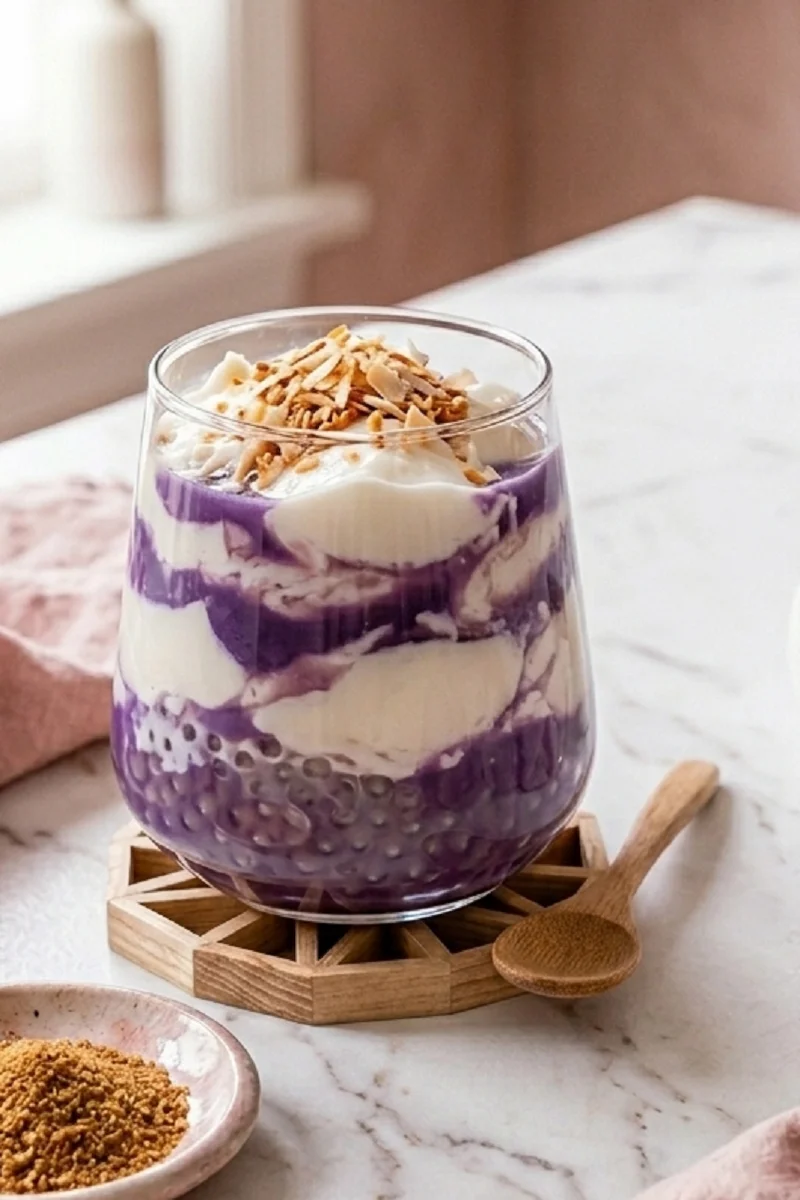
Ube Taho: For the ube syrup in taho, a slightly looser halaya (the spreading consistency borderline) is warmed with coconut milk to create a pourable syrup. Full instructions are in our ube taho recipe. One batch of ube halaya makes enough syrup for approximately 20 to 25 taho servings.
Halo-halo: The most iconic Filipino dessert, a layered shaved ice concoction, typically uses one to two tablespoons of ube halaya as one of many layers under the shaved ice. The jam is used at room temperature or slightly chilled, softened enough to spoon easily.
Bibingka and puto: Traditional Filipino rice cakes often use ube halaya as a filling or topping. For bibingka, a teaspoon of halaya placed in the center of each rice cake before baking creates a soft, fragrant ube pocket. For puto, it is swirled into the batter or used as a topping.
Ube ice cream: Used as a ribbon or mix-in during the churning process, or as a topping spooned over scoops at serving. The sweetness and creaminess of ube halaya complement the neutral dairy base of plain ice cream naturally.
Modern Applications for Homemade Ube Jam
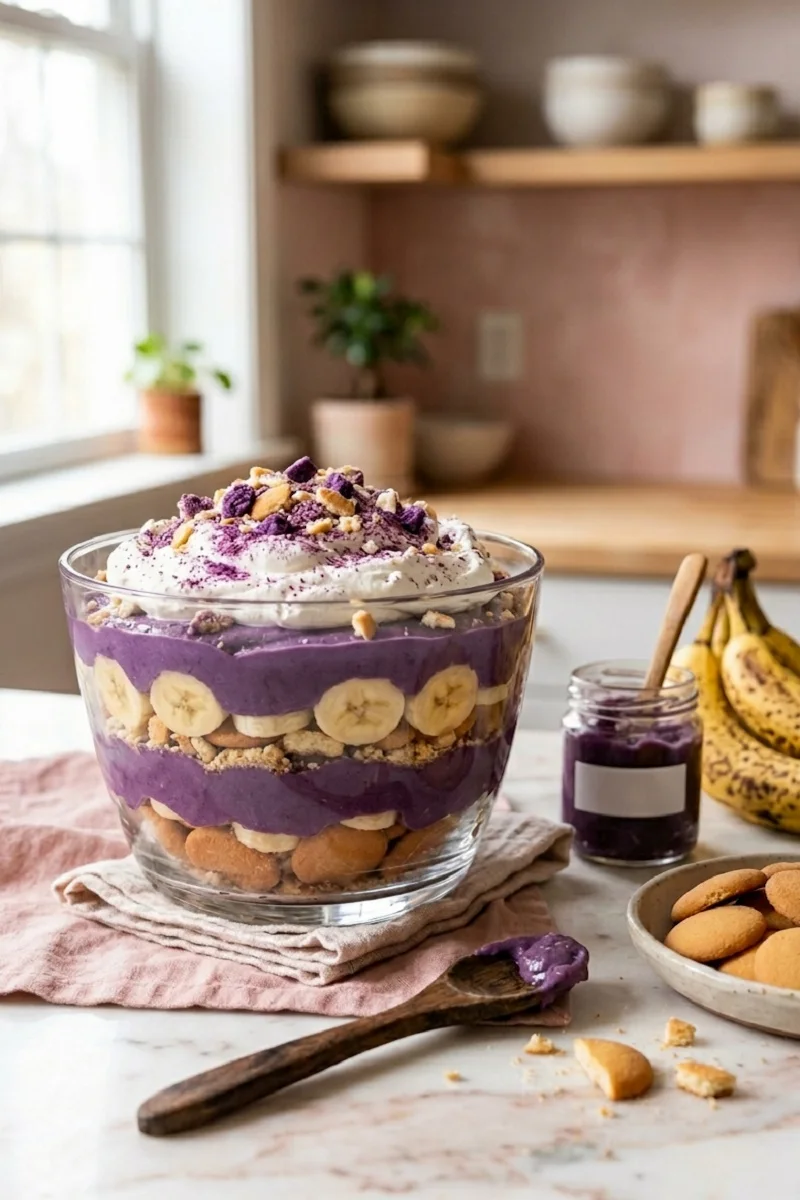
Ube banana pudding: The ube custard in our ube banana pudding recipe uses 200 g of ube halaya as the base for the custard layer. Using homemade halaya rather than store-bought produces a noticeably more fragrant and complex custard in the final pudding.
Cake frosting and filling: Ube halaya can be folded into buttercream (at a ratio of roughly 1:2 halaya to butter) for a purple ube buttercream that is genuinely flavored rather than just colored. It can also be used straight as a filling between cake layers, particularly in chiffon or sponge cakes where its moisture content softens the layers pleasantly.
Swirl cheesecake: Warm ube halaya slightly to a pourable consistency and swirl it into a cheesecake batter before baking. The contrast between the cream cheese base and the ube is both visual (white and purple swirls) and flavor-balanced (tangy dairy and earthy sweet yam).
Donut filling: For a piping consistency, cook the halaya until the line drawn through it holds for 5+ seconds. Fill a piping bag and inject it into freshly fried donuts for one of the most popular modern Filipino-American pastry applications. The ube donut market in Filipino-American bakeries is significant, and homemade halaya filling is considerably better than the commercial alternatives most use.
Everyday Breakfast and Snack Uses
On pandesal: The most Filipino everyday use. Pandesal (small, slightly sweet Filipino bread rolls) with ube halaya spread is a morning combination that requires almost no preparation once you have a jar in the refrigerator. It is comforting, inexpensive, and genuinely delicious.
Swirled into oatmeal: A tablespoon of ube halaya stirred into warm oatmeal adds sweetness, color, and flavor without requiring additional sugar. It also adds nutritional substance from the ube itself, including the anthocyanins discussed in the science section.
On toast, crepes, and pancakes: Any application where you would use fruit jam works equally well with ube halaya. Its consistency when cold is similar to a thick jam; at room temperature it softens to easy spreading consistency.
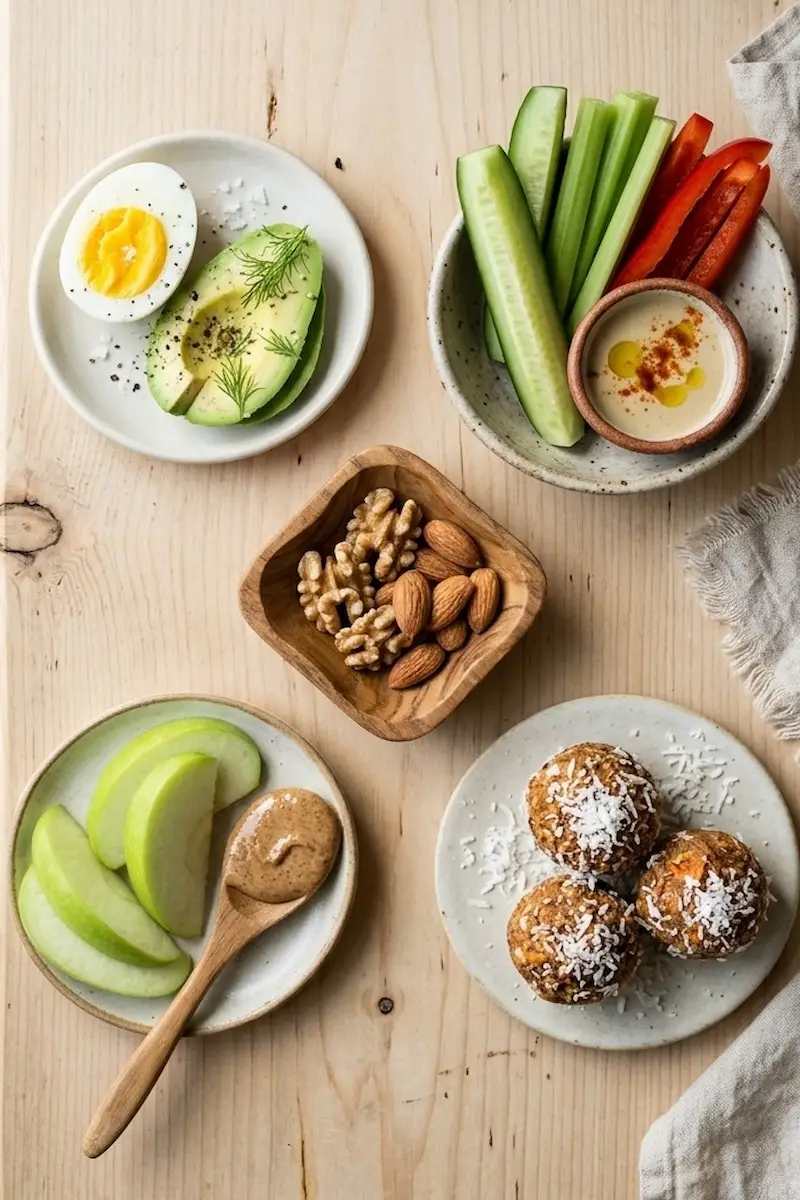
For a broader set of snack and breakfast ideas that incorporate Filipino ingredients and whole-food thinking, our Mark Hyman snack ideas guide covers the Pegan snack philosophy that makes room for culturally rich treats like ube as part of a varied, whole-food approach to eating.
Ube Halaya Storage and Shelf Life
Proper Storage Techniques
The primary enemies of homemade ube halaya are moisture contamination and oxidation. Both shorten shelf life and degrade quality faster than the jam’s natural preservation properties can compensate for.
- Use glass jars with tight-fitting lids. Wide-mouth mason jars or repurposed commercial jam jars work well. Wash and dry them thoroughly before use.
- Fill jars while the halaya is still hot, within a few minutes of finishing cooking. Hot halaya flows into the jar easily and the temperature creates a light vacuum seal as it cools, extending shelf life.
- Press a piece of plastic wrap directly onto the surface of the halaya before putting the lid on. This eliminates the air gap at the top that allows oxidation, which is what causes surface discoloration in stored halaya.
- Always use a clean, dry spoon when removing halaya from the jar. Contaminating the jar with moisture or crumbs from previous food introduces spoilage organisms.
How Long Does Ube Halaya Last?
| Storage method | Shelf life | Quality notes |
| Refrigerated (sealed jar) | 2 to 3 weeks | Best quality in first 10 days; slight flavor mellowing after that |
| Frozen (proper packaging) | 3 to 4 months | Texture may be very slightly grainy after thawing; whisk or warm gently to restore |
| Room temperature | 2 to 3 days maximum | Only acceptable in cool climates; not recommended in warm environments |
| Opened jar, refrigerated | 1 to 2 weeks | Use clean dry spoon each time; press fresh plastic wrap onto surface after each use |
Signs of spoilage: Visible mold growth (any color), sour or off smell (not the normal sweet-earthy ube smell), unusual separation into clearly watery and solid portions, or any pink or orange color development at the surface. Discard the jar if any of these are present.
Freezing and Thawing Guide
Freezing is the most practical way to extend the shelf life of a large batch, and it is how many home cooks manage the fact that one ube halaya recipe produces more than most recipes immediately require.
- Portion the cooled (not warm) halaya into a silicone ice cube tray. Standard ice cube sizes (approximately 2 tablespoons each) are a useful unit for most recipes.
- Freeze until completely solid, approximately 4 to 6 hours.
- Pop the frozen cubes out of the tray and transfer to a zip-lock freezer bag. Remove as much air as possible before sealing. Label with the date.
- To thaw: remove the number of cubes needed and thaw overnight in the refrigerator. Do not microwave frozen ube halaya; the uneven heating causes texture damage.
- Once thawed, use within 3 to 4 days and do not refreeze. If the texture seems grainy after thawing, warm gently in a small saucepan over low heat with a splash of coconut milk or evaporated milk, stirring until smooth.
Frequently Asked Questions About Ube Halaya
What does ube halaya taste like?
Ube halaya has a flavor that is genuinely its own and difficult to map precisely onto other foods. The most common descriptions are earthy, faintly nutty (some say pistachio-adjacent), and gently vanilla-like, with a sweetness that comes from both the natural sugars in the yam and the condensed milk. It is not as intensely sweet as fruit jam. It is not as one-dimensional as pure sugar. The earthy quality is the most distinctive element: it is a cooked vegetable sweetness rather than a fruit sweetness, which gives it an unusual warmth that pairs beautifully with dairy (whipped cream, ice cream, and custard) and with neutral starches (bread, rice cakes, and pastry). People who expect it to taste like purple candy are usually surprised that it is more complex and more savory than they anticipated.
Is ube halaya the same as ube jam?
Yes. Ube halaya and ube jam are the same thing: a cooked jam or preserve made from purple yam (Dioscorea alata). The word “halaya” is the Filipino term, derived from the Spanish “jalea.” In English, it is commonly called purple yam jam, Filipino ube jam, or simply ube jam. Some recipes use slightly different ingredient ratios or preparation methods, but all refer to the same fundamental product: cooked and sweetened purple yam in a spreadable or pipeable form.
Can I use purple sweet potato instead of ube?
You can, and the result will be a reasonable purple jam, but it will not be ube halaya. Purple sweet potato (Ipomoea batatas) and ube (Dioscorea alata) are botanically unrelated and distinctly different in flavor, texture, and color intensity. Purple sweet potato has a sweeter, moister, more potato-like quality and produces a less vivid purple color than genuine ube. The resulting jam lacks the earthy, nutty depth that makes ube halaya distinctive. If ube is unavailable and purple sweet potato is your only option, the jam will be pleasant and purple. It is not a substitute of equal quality; it is a different product.
Where can I buy ube halaya or frozen grated ube?
Filipino grocery stores are the most reliable source for both. Most major cities in the United States, Canada, Australia, and the United Kingdom with a Filipino community have at least one Filipino specialty store that stocks frozen grated ube and multiple brands of store-bought ube halaya. Pan-Asian supermarkets (such as H Mart, 99 Ranch, and similar chains) increasingly carry both. Online, frozen grated ube can be found through Filipino food specialty retailers, and store-bought ube halaya is available through Amazon and similar platforms. Ube extract, which is a different product, is available at most baking supply stores.
Is ube halaya healthy?
Ube halaya is a sweetened jam made with condensed milk and butter. It is a dessert ingredient, not a health food, and approaching it as such is the right frame. A two-tablespoon serving contains approximately 85 to 95 calories, primarily from sugar and fat. What ube halaya does contain that most jams do not is a meaningful contribution of anthocyanin antioxidants from the purple yam, the same class of compounds studied for anti-inflammatory and cardiovascular benefits in blueberries and other purple-pigmented foods. These benefits are present but reduced by the cooking process. The healthiest way to use ube halaya is in moderate amounts within a varied diet, enjoying it for what it is rather than medicinalizing it.
Can I make ube halaya vegan?
Yes, with straightforward substitutions. Replace sweetened condensed milk with coconut condensed milk (sweetened condensed coconut milk), which is available at most health food stores and online. Replace unsalted butter with refined coconut oil (refined has a neutral flavor; unrefined adds coconut taste that can be pleasant in ube halaya but changes the flavor profile). Replace evaporated milk with full-fat coconut milk. The resulting vegan ube halaya has a more pronounced coconut flavor than the dairy version, which is a natural complement to ube. The texture is similar; the shelf life may be slightly shorter. All other steps remain the same as the stovetop method.
Why is my ube halaya too runny or too thick?
Too runny: the most common cause is not cooking long enough. Return the halaya to the pan over medium-low heat and cook, stirring continuously, until it reaches the desired consistency. The second most common cause is using ube with very high moisture content (fresh ube that is very wet or frozen ube that was not fully drained before steaming). Allow more evaporation time in future batches. A runny halaya can also be thickened by whisking in one tablespoon of cornstarch dissolved in two tablespoons of cold milk and cooking for an additional 3 to 5 minutes. Too thick: the halaya was cooked past the target consistency or cooled too much before checking. Warm gently in a saucepan over low heat with 2 to 3 tablespoons of coconut milk or evaporated milk, stirring until you reach the right consistency. Add liquid a tablespoon at a time to avoid over-thinning.
Common Mistakes That Ruin Ube Halaya
Not Cooking Long Enough
Under-cooked ube halaya is runny, will not hold its shape in applications, and has a significantly shortened shelf life because excess moisture supports faster microbial growth. The most reliable test for doneness is the cold plate test: put a small spoonful of the jam on a cold plate from the refrigerator and let it sit for 60 seconds. Push it with your finger: it should move as a cohesive mass, not run freely. If it runs, keep cooking. The 30 to 45 minute cooking time in the stovetop recipe is a guideline; actual time varies significantly based on the moisture content of the ube you use. Trust the visual and tactile tests over the clock.
Overcooking and Burning
The window between perfectly cooked and overcooked ube halaya is narrow, particularly in the final 5 minutes of the stovetop method when the jam is thickest and the risk of scorching is highest. Overcooked halaya is dark, very sticky, bitter at the edges, and difficult to spread. It smells faintly of burned sugar rather than ube. Prevention: Keep the heat consistently at medium-low throughout (not medium, not low-medium; medium-low); never stop stirring during the final thickening phase; and remove from heat the moment the spatula line test indicates the right consistency. If you smell anything approaching caramel or burning, take the pan off heat immediately and stir vigorously away from the heat source.
Using Low-Quality or Mislabeled Ube
The most common quality issue is accidentally purchasing taro or purple sweet potato labeled as ube, either through mislabeling at the market or through a language barrier when shopping. Taro has a grayish-purple to white interior and a distinctly different flavor (starchier, more neutral). Purple sweet potato has a pinker-purple flesh and a sweeter, more potato-like flavor. Neither produces the same result as genuine ube. When purchasing fresh or frozen ube, look specifically for Dioscorea alata or ask at a Filipino grocery store where staff will know the product. Genuine ube has a vivid, deep purple flesh all the way through, even in the raw state, and produces a strongly aromatic steam when cooking.
Adding Too Much Sugar
The single most common flavoring error in homemade ube jam recipe production. Sweetened condensed milk is already very sweet, and ube has its own natural sugars. Many first-time makers add the full amount of additional sugar called for in a recipe before tasting and end up with a cloyingly sweet halaya where the ube flavor is buried under sweetness. The rule: taste before adding any sugar beyond the condensed milk, and add additional sugar only in small increments, tasting after each addition. A well-balanced ube halaya should taste distinctly of ube first and sweet second. If you taste sweet first and have to search for the ube, the balance is off.
Conclusion: Master the Foundation of Filipino Desserts
Ube halaya is the ingredient that unlocks the entire Filipino ube dessert canon. With a jar of homemade purple yam jam in the refrigerator, you have the base for ube taho syrup, ube banana pudding custard, ube frosting, ube filled pastries, and a dozen everyday applications from toast to oatmeal. It takes an afternoon to make in a meaningful quantity and lasts weeks.
The three methods here cover every practical scenario: the stovetop method when you want the best possible flavor and have 45 minutes; the Instant Pot method when consistency and speed matter more than maximum depth; the no-cook method when you need a tablespoon for an immediate application and do not want to dirty a pan. Master the stovetop method first. The experience of watching ube puree, condensed milk, and butter slowly transform into a glossy, fragrant purple jam through nothing more than heat and patience is one of the most satisfying things you can do in a kitchen.
For the two flagship recipes that use this halaya, our ube taho recipe and ube banana pudding guide are the natural next steps once you have a jar ready to go.
💜 Love This Purple Yam Jam?
Save our ube halaya recipe to Pinterest! Get all 3 cooking methods (stovetop, Instant Pot & no-cook), ingredient tips, and storage secrets—all in one beautiful, easy-to-reference pin.
📌 Save Recipe on Pinterest →Join thousands making authentic Filipino purple yam jam at home!
📖 Related Reading: Your Filipino Dessert Toolkit
Explore ube recipes, purple food science, and balanced meal ideas
🇵🇭 More Filipino-inspired recipes at JoyfulBiteRecipes.com