
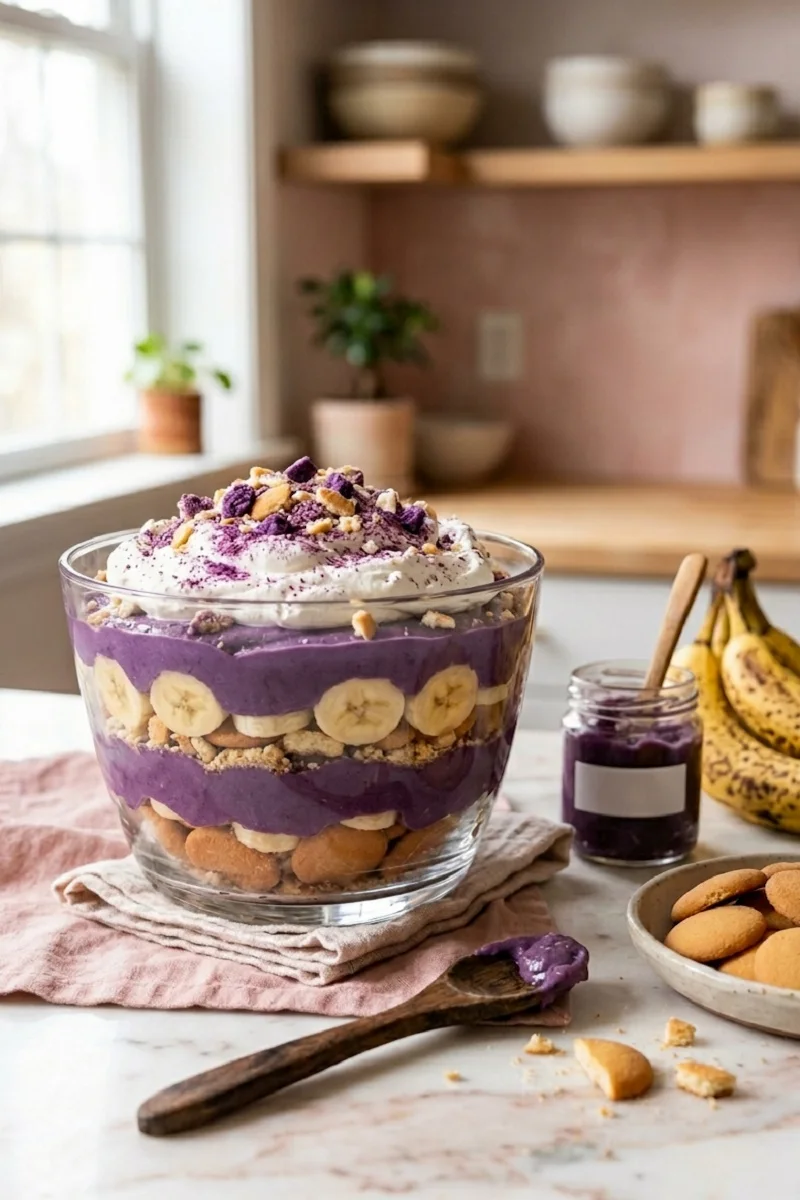
Ube banana pudding is exactly what happens when two iconic comfort food traditions meet in the same bowl and immediately make each other better. The American South gave us banana pudding: ripe bananas, creamy vanilla custard, softened wafers, and whipped cream in a dish that has been the centerpiece of family gatherings for generations. The Philippines gave us ube: a purple yam with an earthy, subtly nutty flavor and a color so vivid it looks almost artificial even when it is entirely natural.
Together they create something that is both instantly familiar and genuinely surprising. The layers look dramatically different from any banana pudding you have seen before. The flavor is recognizably a pudding, but with a depth and complexity that plain vanilla custard does not offer. And the color, that deep, rich purple running through each layer of the glass dish, makes it one of the most visually striking desserts you can bring to a gathering.
This recipe covers every component in detail: the ube custard from scratch, the banana preparation to prevent browning, the layering technique for visual impact, and everything you need to know about making it ahead, storing it, and adapting it for different dietary preferences. Total active time is 30 minutes. Then it chills for at least 2 hours while the wafers soften and the flavors meld into something considerably better than the sum of its parts.
Table of Contents
Quick Answer: The Perfect Ube Banana Pudding
🟣 At a Glance: Ube Banana Pudding
What Is Ube Banana Pudding and Why Is It So Special?
The Fusion of Filipino and American Dessert Traditions
Classic American banana pudding, in its definitive Southern form, is a no-bake layered dessert of vanilla custard (or pudding mix), sliced bananas, and vanilla wafers, topped with meringue or whipped cream and served from a wide dish. It is comfort food in the most direct sense: simple, sweet, nostalgic, and deeply associated with family occasions. The wafers soften overnight in the custard into something halfway between a cookie and a cake layer, and the bananas become almost jammy. There is nothing fussy about it, and that lack of fussiness is part of its enduring appeal.
Filipino food culture has its own rich tradition of layered desserts, refrigerator cakes, and sweet snacks collectively called kakanin. The Filipino-American culinary moment of the last decade has produced some of the most creative cross-cultural desserts in contemporary food, as Filipino-American chefs and home cooks began combining the flavors of their heritage with American classics. Ube cheesecake, ube ice cream, ube pancakes, and ube banana pudding are all products of this creative fusion, and ube banana pudding specifically is one of the most natural combinations: the warm, earthy sweetness of ube custard fits the banana pudding format as though it were designed for it.
How Ube Transforms Classic Banana Pudding
The transformation is in the custard. In the classic American version, the custard is a simple vanilla-flavored milk and egg yolk base, pale yellow, mildly sweet, and designed to be a background for the bananas and wafers rather than a flavor in its own right. In the ube version, the custard is the star: deep purple, fragrant with the distinctive earthy-vanilla-nutty quality of purple yam, and rich enough that a spoonful on its own is a genuinely satisfying experience.
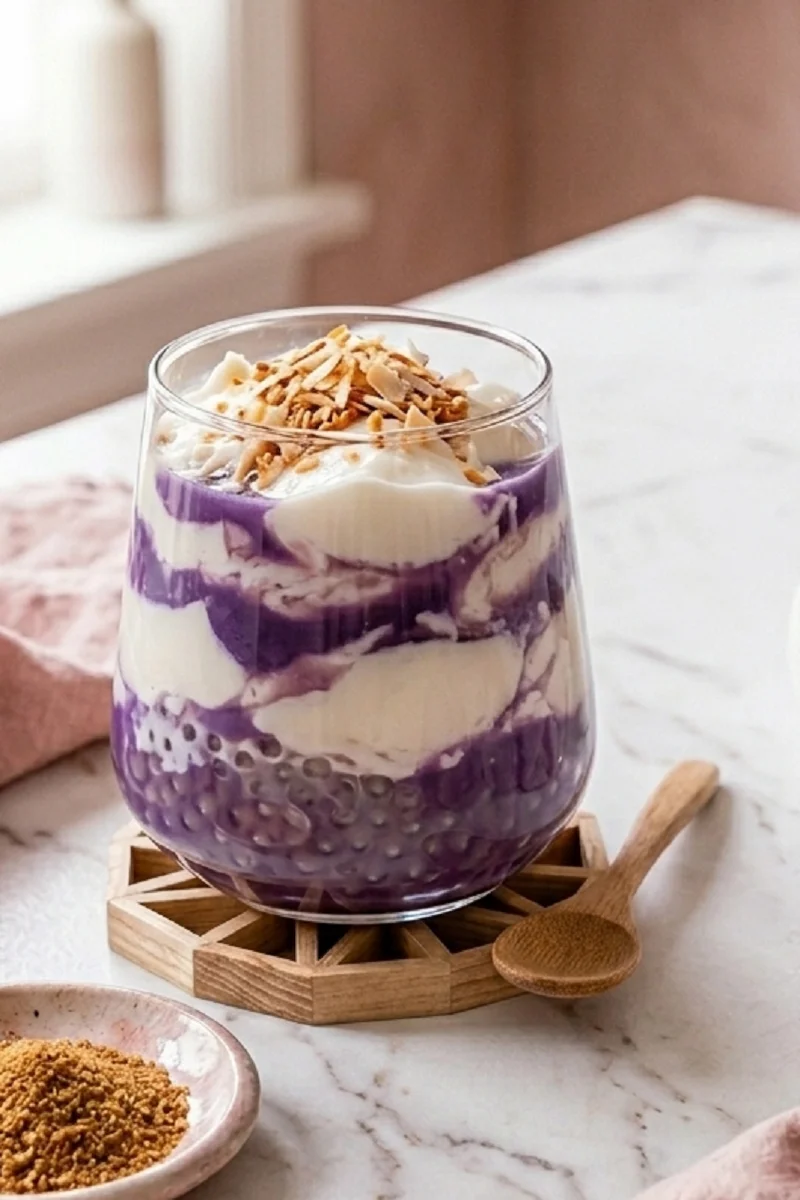
Ube halaya, the purple yam jam used as the base for the custard, adds body and flavor simultaneously. When cooked into a custard base, it creates a texture that is slightly denser and more velvety than plain vanilla custard, which actually improves the layering: ube custard holds its shape between layers better than a lighter custard and produces the clear, defined purple-and-cream alternating layers that make a cross-section of this pudding so visually dramatic.
Ube also contributes natural anthocyanin antioxidants from its vivid pigmentation. Our purple peel weight loss guide covers the science of these compounds in detail, including their documented anti-inflammatory properties and their connection to metabolic health.
Why Ube Banana Pudding Went Viral
The visual explanation is simple: a glass trifle dish or individual glass cups showing clean alternating layers of deep purple custard, pale banana slices, and ivory wafers is genuinely striking in a way that is rare in home cooking. Most food that is delicious does not also photograph dramatically. Ube banana pudding does both. The purple layers read as vivid and distinctive at every exposure level, in natural or artificial light, in wide shots or close-ups. It photographs well without any styling effort beyond assembling it in a clear glass vessel.
Beyond aesthetics, the flavor story resonates: a beloved American classic reimagined with a Filipino ingredient that most American dessert eaters have not tried. The combination of familiarity (banana pudding) and novelty (ube) produces the exact kind of food experience that drives sharing on social media. People who try it want to tell others about it. That word-of-mouth quality is why ube banana pudding spread from Filipino-American bakeries and restaurants into home kitchens as rapidly as it did.
The Nutritional Context of Ube Banana Pudding
Ube banana pudding is a dessert, and approaching it primarily as a health food is not the right frame. It contains sugar, egg yolks, and cream. What it also contains, relative to most comparable desserts, are some genuinely nutritious components that are worth understanding.
Ube’s Antioxidant Profile
Purple yam (Dioscorea alata) owes its vivid color to anthocyanins, the same class of polyphenolic compounds responsible for the color of blueberries, tart cherries, and red cabbage. In ube specifically, the primary anthocyanins identified are cyanidin and peonidin derivatives, compounds with documented antioxidant and anti-inflammatory activity in research settings. These compounds are heat-sensitive: some are degraded during cooking of the ube halaya and further during the custard-making process. The cooked, cream-enriched custard retains meaningful but reduced anthocyanin content compared to raw ube.
For the maximum nutritional impact of anthocyanins from purple-pigmented foods, consuming them with less processing (raw or briefly cooked) is more effective than consuming them in a cream-based custard. That said, ube banana pudding is not a primary vehicle for antioxidant intake; it is a dessert that happens to contain a more nutritionally interesting ingredient than standard vanilla custard. Our flat belly blueberry smoothie guide covers the anthocyanin research in detail for readers who want to maximize this compound class through diet.
Bananas: Potassium, Prebiotic Fiber, and Natural Sweetness
Bananas contribute meaningfully to the nutritional profile of this dessert. A medium ripe banana provides approximately 422 mg of potassium (roughly 12% of the daily requirement), 3 grams of fiber (including resistant starch and fructooligosaccharides that feed beneficial gut bacteria), and 14 grams of naturally occurring sugars with a moderate glycemic index that is lower than most refined sweeteners. The riper the banana, the more the starch has converted to sugar: a spotty, very ripe banana is sweeter but also higher in readily available glucose than a firm, lightly spotted banana. For this recipe, ripe but not overripe bananas (well-spotted but still firm enough to slice cleanly) produce the best balance of sweetness and texture.
Making It More Nutrient-Dense
For people who want to enjoy this dessert with a more favorable nutritional profile:
- Replace heavy cream in the custard with full-fat coconut milk: reduces saturated fat from dairy while adding a complementary tropical flavor that suits the ube well.
- Reduce the sugar in the custard by 25 to 30% and compensate with an additional teaspoon of pure vanilla extract, which enhances the perception of sweetness without adding calories.
- Use whole-grain digestive biscuits or a lightly sweetened granola in place of some or all of the vanilla wafers for additional fiber.
- Add a layer of plain Greek yogurt (thinned slightly with a tablespoon of coconut milk to make it pourable) between the custard and banana layers for an additional 4 to 5 grams of protein per serving.
For more on building treats that balance indulgence with nutritional substance, our Mark Hyman snack ideas guide covers the broader philosophy of whole-food-oriented eating that makes room for desserts as part of a varied, balanced diet.
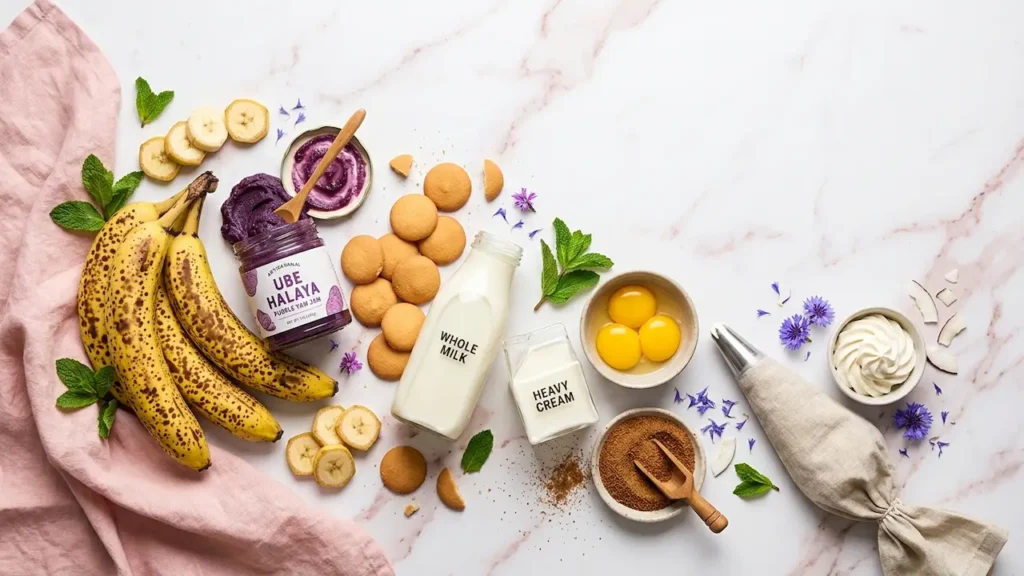
The Best Ube Banana Pudding Recipe: Step-by-Step
The Functional Ingredient Stack
| Ingredient | Amount | Notes and substitutions |
| Ripe bananas | 4 to 5 medium (spotty, firm) | Well-spotted but still firm; overripe bananas turn mushy when layered |
| Ube halaya (purple yam jam) | 200 g (3/4 cup) | Sweetened: reduce custard sugar to 40 g if using sweetened halaya |
| Whole milk | 480 ml (2 cups) | Do not substitute skim or 2% milk; fat content is needed for custard texture |
| Egg yolks | 4 large | Room temperature; cold yolks can cause custard to curdle |
| Heavy whipping cream (for custard) | 120 ml (1/2 cup) | Sub: full-fat coconut milk for dairy-free version |
| Coconut sugar or muscovado | 60 to 80 g (1/3 cup) | Adjust based on sweetness of ube halaya |
| Cornstarch | 3 tablespoons (24 g) | Essential thickener; do not omit or reduce |
| Pure vanilla extract | 1.5 teaspoons | Split: 1 tsp in custard, 1/2 tsp in whipped cream |
| Sea salt | 1/4 teaspoon | Sharpens and balances all flavors; do not omit |
| Unsalted butter | 2 tablespoons | Whisked in off-heat for gloss and silkiness; optional but recommended |
| Vanilla wafers | 200 g (approximately 50 wafers) | Sub: digestive biscuits, graham crackers, or shortbread |
| Heavy cream (for topping) | 360 ml (1.5 cups) | Cold; must be cold to whip properly |
| Powdered sugar (for whipped cream) | 2 tablespoons | Sub: monk fruit powder for reduced sugar version |
| Lemon juice (for bananas) | 1 tablespoon | Prevents oxidative browning on cut banana surfaces |
| Ube extract (optional) | 1/4 to 1/2 teaspoon | Boosts color only, not a flavor substitute for halaya |
🍌 Pro Tip: Banana Selection Matters
The single most impactful ingredient choice in this recipe is the banana ripeness. Here’s why it matters:
💡 Visual cue: Look for bananas that are still firm to the touch but have plenty of brown freckles—this is the sweet spot for ube banana pudding!
Step-by-Step Preparation
Step 1: Make the ube custard base.
In a medium heavy-bottomed saucepan, whisk together the egg yolks, cornstarch, and coconut sugar until pale and slightly thickened, about 2 minutes. This step ensures the cornstarch is fully incorporated into the egg mixture before heat is applied, which prevents lumps in the final custard. Add the whole milk and heavy cream gradually, whisking constantly, until fully combined.
Place the saucepan over medium heat. Add the ube halaya and whisk continuously as the mixture heats. The ube halaya is thick and will resist fully dissolving until the mixture warms; after 4 to 5 minutes of continuous whisking, the mixture will smooth out into a uniformly purple liquid. Continue whisking and cooking over medium heat until the custard thickens enough to coat the back of a spoon and a line drawn through it holds its shape, approximately 8 to 12 minutes total. Do not stop whisking at any point during cooking.
Remove from heat. Add the vanilla extract, sea salt, and butter (if using). Whisk until the butter is fully incorporated and the custard is glossy. If adding ube extract for a deeper color, add it now. Taste and adjust salt. Pour the custard into a shallow bowl or baking dish, press plastic wrap directly onto the surface (this prevents a skin from forming), and refrigerate until cooled but not cold, approximately 30 to 40 minutes. The custard should be at room temperature or slightly cooler than body temperature when you layer: too hot and it will make the wafers soggy instantly; too cold and it pours poorly and breaks banana slices.
Step 2: Prepare the bananas.
Slice the bananas into rounds approximately 5 mm (1/4 inch) thick. Thinner slices break during layering; thicker slices create structural gaps in the layers. Place the sliced bananas in a bowl and toss gently with the tablespoon of lemon juice. The lemon juice coats the cut surfaces and slows enzymatic browning significantly. The bananas will still begin to brown eventually, which is why this pudding benefits from being assembled and refrigerated promptly.
Step 3: Whip the cream.
Using a stand mixer or hand mixer with a whisk attachment, whip the cold heavy cream with the powdered sugar and remaining vanilla extract on medium-high speed until it forms stiff peaks. The cream must be cold (refrigerator temperature); warm cream will not whip to stiff peaks. Set aside and refrigerate while you assemble the pudding.
Step 4: Layer the pudding.
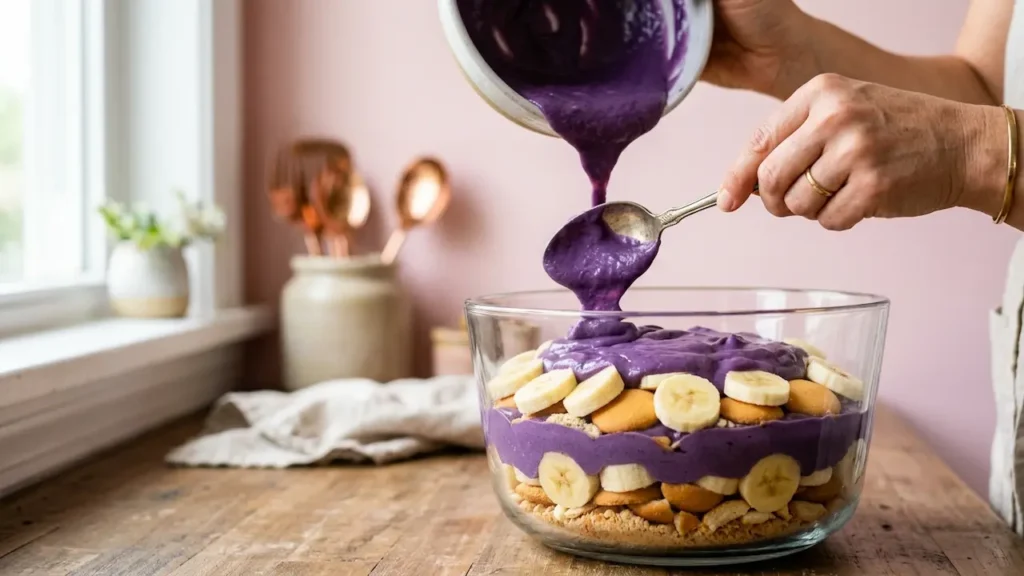
Choose a clear glass trifle dish, a 23 x 33 cm (9 x 13 inch) glass baking dish, or individual glass cups or jars for individual servings. The layers from bottom to top: a single layer of vanilla wafers (arrange them tightly, covering the base completely), a single layer of banana slices (place them over and between the wafers), a generous layer of ube custard (pour or spoon it evenly over the bananas, using approximately one-third of the total custard per layer). Repeat this sequence twice more, ending with a custard layer as the top layer before the whipped cream.
Spread or pipe the whipped cream over the final custard layer. Garnish with a few reserved wafer crumbles, banana slices (added immediately before serving to prevent browning at this stage), or a dusting of crushed vanilla wafers mixed with a small amount of ube halaya for a purple crumble topping.
Step 5: Chill and serve.
Cover the assembled pudding with plastic wrap (press it against the whipped cream surface if you want to avoid any condensation pooling) and refrigerate for a minimum of 2 hours. Overnight chilling (8 to 12 hours) produces a significantly better result: the wafers soften fully into a cake-like layer, the custard sets firmly enough to scoop cleanly, and the banana flavor permeates the custard layers in a way that does not happen in a short chill. If serving at a gathering, make this the day before.
Layering Secrets for Perfect Visual Impact
Even banana slices. Consistent 5 mm thickness means the banana layer sits flat and the custard above it distributes evenly. Uneven slices create high spots where the custard pools and thin spots where the banana shows through. Use a sharp knife and a slow, controlled slicing motion: a banana does not need to be sawed.
Custard temperature. Warm custard soaks into the wafers immediately on contact, which produces a soggy, uniform texture without distinct layers. Cooled custard (to room temperature or slightly below) sits on top of the wafers and banana slices without immediately penetrating, allowing the layers to remain distinct during assembly. They will meld during the chilling period, which is exactly what you want, but the melding should be gradual rather than immediate.
Use a clear glass dish. The visual impact of this dessert is entirely dependent on the layers being visible from the side. A ceramic or opaque dish conceals the most striking element. A wide, shallow glass trifle dish or individual glass jars or rock glasses produce the most dramatic presentation. The wider the dish, the more defined and visible each layer appears from above and from the side.
Reserve some custard for the final layer. The most common assembly error is running out of custard at the top layer because earlier layers were too generous. Divide the custard mentally into thirds before you begin: one-third per layer, no more, so that the top layer has the same visual presence as the lower ones.
Ube Banana Pudding
Ube Banana Pudding combines the creamy comfort of classic Southern banana pudding with the rich, earthy sweetness of Filipino ube. Layers of silky purple yam custard, ripe bananas, vanilla wafers, and whipped cream create a stunning make-ahead dessert that is as beautiful as it is delicious.
- Prep Time: 20 minutes
- Cook Time: 10 minutes
- Total Time: 2 hours 30 minutes
- Yield: 8 to 10 servings 1x
- Category: Dessert
- Method: No-Bake
- Cuisine: Filipino-American
- Diet: Vegetarian
Ingredients
- 4 to 5 medium ripe bananas, sliced
- 200 g ube halaya (purple yam jam)
- 2 cups whole milk
- 1/2 cup heavy whipping cream (for custard)
- 4 large egg yolks
- 1/3 cup coconut sugar or muscovado sugar
- 3 tablespoons cornstarch
- 1 1/2 teaspoons pure vanilla extract, divided
- 1/4 teaspoon sea salt
- 2 tablespoons unsalted butter (optional)
- 200 g vanilla wafers
- 1 1/2 cups heavy whipping cream, cold
- 2 tablespoons powdered sugar
- 1 tablespoon lemon juice
- 1/4 to 1/2 teaspoon ube extract (optional)
Instructions
- Whisk egg yolks, cornstarch, and coconut sugar in a saucepan until smooth and pale.
- Gradually whisk in whole milk and heavy cream until fully combined.
- Add ube halaya and place over medium heat.
- Cook while whisking constantly until the custard thickens and coats the back of a spoon, about 8 to 12 minutes.
- Remove from heat and whisk in vanilla extract, sea salt, butter, and ube extract if using.
- Press plastic wrap directly onto the custard surface and cool for 30 to 40 minutes.
- Slice bananas into 1/4-inch rounds and toss gently with lemon juice.
- Whip cold heavy cream with powdered sugar and remaining vanilla extract until stiff peaks form.
- Arrange a layer of vanilla wafers in a clear glass dish.
- Add a layer of banana slices over the wafers.
- Spread one-third of the ube custard over the bananas.
- Repeat the layers two more times, ending with custard on top.
- Spread or pipe whipped cream over the final custard layer.
- Garnish with crushed vanilla wafers or fresh banana slices.
- Cover and refrigerate for at least 2 hours, preferably overnight.
- Serve chilled and enjoy.
Notes
For the best texture and flavor, prepare this dessert the day before serving. Use ripe bananas with brown freckles but still firm enough to slice cleanly. Real ube halaya provides superior flavor and texture compared to ube extract alone. Store covered in the refrigerator for up to 3 days.
Nutrition
- Serving Size: 1 serving
- Calories: 350
- Sugar: 28g
- Sodium: 170mg
- Fat: 18g
- Saturated Fat: 11g
- Unsaturated Fat: 5g
- Trans Fat: 0g
- Carbohydrates: 47g
- Fiber: 3g
- Protein: 6g
- Cholesterol: 115mg
Strategic Pairing: Complete Your Ube Banana Pudding Experience
Best Beverages to Pair With Ube Banana Pudding
Ube banana pudding is sweet, creamy, and rich, with a dense, filling quality after the chilling period. The best beverage pairings cut through the richness without competing with the ube flavor.
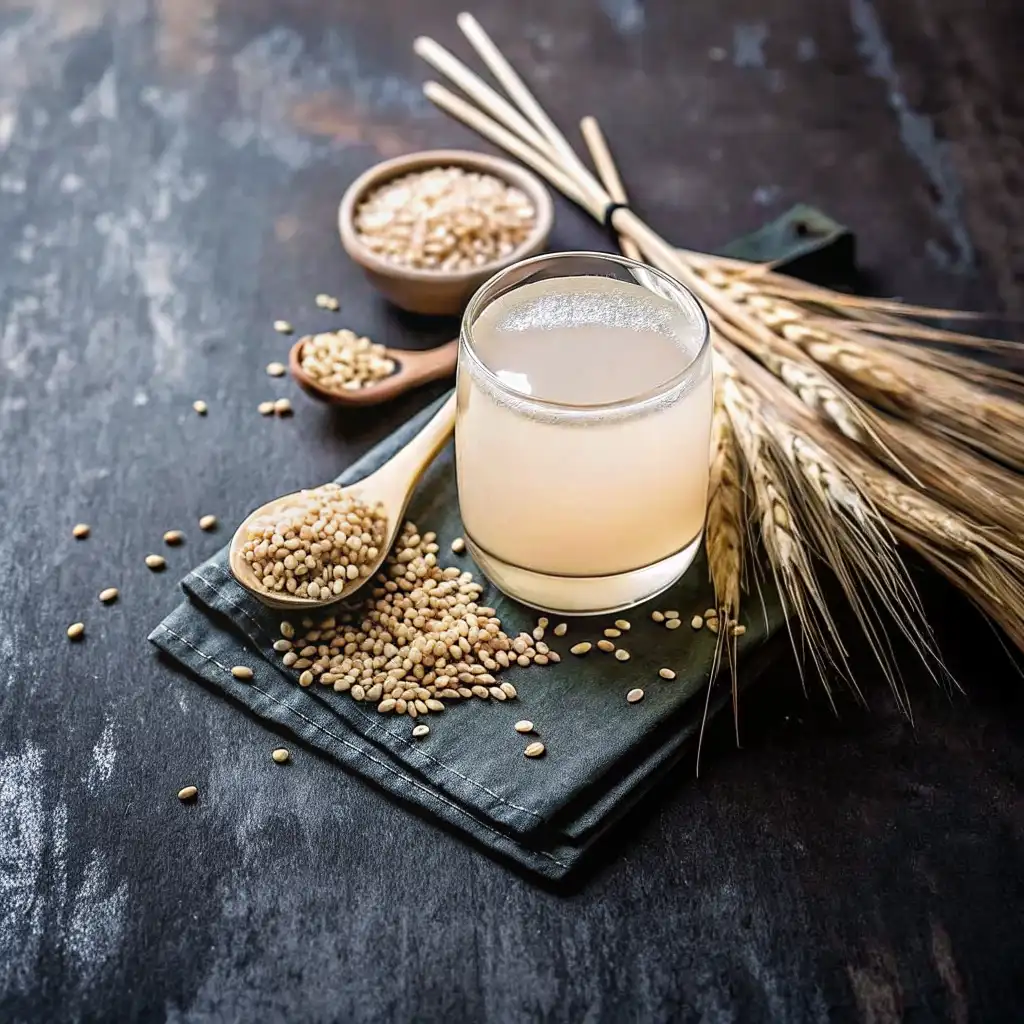
Roasted barley tea (mugicha): The toasty, slightly bitter quality of roasted barley tea is an ideal counterpoint to the sweetness and creaminess of ube banana pudding. The bitterness functions the same way that coffee does alongside dessert: it cleanses the palate between bites and prevents the sweetness from becoming cloying. It is also caffeine-free, which makes it appropriate at any time of day including the evening. Our roasted barley tea guide covers preparation and the prebiotic gut health benefits of regular consumption.
Warm calamansi tea: A few calamansi squeezed into hot water with a small amount of honey provides the same palate-cleansing citrus acidity as coffee without the caffeine. The brightness of calamansi contrasts beautifully with the earthiness of the ube. If fresh calamansi are unavailable, equal parts fresh lime juice and fresh orange juice in hot water makes a reasonable approximation.
Cold coconut water: Served very cold alongside a generous portion, coconut water provides electrolyte replacement and a clean, mildly sweet flavor that does not compete with the pudding. This is the most appropriate pairing for outdoor or summer gatherings.
When to Enjoy Ube Banana Pudding
Parties and gatherings (the ideal context): Ube banana pudding is fundamentally a sharing dessert. Made in a large trifle dish and set on a table, it generates immediate conversation from its appearance alone. It serves 8 to 10 from one recipe, it is made the day before (no day-of stress), and it requires only a large spoon to serve. This is its natural habitat.
Filipino merienda (afternoon snack): A smaller portion in an individual glass jar, prepared at home, works well as an afternoon treat. The combination of carbohydrate from the wafers and banana, protein from the egg-yolk custard and any Greek yogurt layer, and fat from the cream provides genuine satiety that extends through the pre-dinner gap. Our Mark Hyman snack ideas guide covers the broader philosophy of balanced afternoon snacking that keeps blood sugar stable through the most common hunger window of the day.
Small evening treat: A small spoonful from a pre-assembled individual jar makes a reasonable post-dinner dessert without the caloric impact of a full serving. The protein from the custard and the filling quality of a chilled dessert make this a more satiating option than many lighter-seeming alternatives.
Ube Banana Pudding Variations and Customizations
Classic Filipino-Style Ube Banana Pudding
The most Filipino version uses saba bananas (Musa paradisiaca), the cooking banana native to the Philippines, which are shorter, starchier, and slightly more savory than Cavendish bananas. Saba bananas are typically available at Filipino and Asian grocery stores. They produce a more textured, less sweet layer than standard bananas, which contrasts more distinctly with the sweet ube custard. Muscovado sugar (unrefined cane sugar with a strong molasses flavor) replaces coconut sugar for a deeper, more caramel-toned sweetness. Coconut milk replaces the heavy cream in the custard for a fully dairy-free base with a distinctly Filipino tropical quality.
Healthier Ube Banana Pudding
For a version with a more favorable nutritional profile:
- Replace half or all of the heavy cream in the custard with full-fat Greek yogurt (fold it in after the custard cools off the heat rather than cooking it into the custard, as high heat breaks yogurt down). This adds approximately 4 grams of protein per serving and reduces fat.
- Reduce coconut sugar from 80 g to 50 g and compensate with an additional teaspoon of vanilla extract and a slightly larger pinch of sea salt.
- Replace vanilla wafers with a lightly sweetened granola or whole-grain digestive biscuit for higher fiber content and a more complex flavor.
- For the topping, use Greek yogurt stiffened with a tablespoon of honey instead of whipped cream, which reduces the fat content significantly and adds protein.
Our low-carb cobb salad guide covers the broader approach to macronutrient balance in daily eating that makes room for desserts like this one as part of a genuinely healthy, sustainable diet.
Vegan Ube Banana Pudding
A completely vegan version is achievable with a few substitutions:
- Replace whole milk and heavy cream in the custard with full-fat coconut milk (one 400 ml can). The coconut flavor pairs naturally with ube.
- Replace egg yolks with 3 tablespoons of cornstarch (total, up from 3 in the original, to compensate for the lack of egg thickening) plus 2 tablespoons of cashew butter whisked into the coconut milk base for richness.
- For the whipped topping, use refrigerated full-fat coconut cream (the solid portion from a can refrigerated overnight), whipped with powdered sugar in the same way as heavy cream.
- Check vanilla wafer ingredient lists; many contain butter or milk. Vegan vanilla wafers are available from specialty brands, or substitute with vegan graham crackers.
The texture of the vegan version is slightly different: coconut milk custard is softer and less glossy than egg yolk custard, and the topping is slightly less stable than dairy whipped cream. But the flavor is genuinely excellent, and the coconut notes actually enhance the ube in a way that dairy does not.
Ube Banana Pudding Parfait (Individual Servings)
For parties, meal prep, or elegant presentation, assemble the pudding in individual serving glasses (rocks glasses, mason jars, or clear dessert cups) rather than a large dish. Each glass gets three complete layers: a small layer of wafers, a few banana slices, and a spoonful of custard, repeated once, topped with whipped cream and garnish. Individual parfaits are easier to transport, easier to serve without a serving spoon, and visually more dramatic when displayed on a table because each guest can see the full cross-section of layers from the side of their own glass.
For the full ube dessert experience, our ube taho recipe covers another classic ube preparation, this time in the warm silken tofu street food format, which makes a complementary offering alongside the cold banana pudding at a Filipino-inspired gathering.
Frequently Asked Questions About Ube Banana Pudding
What does ube banana pudding taste like?
Ube banana pudding tastes like the best banana pudding you have ever had, but with a flavor layer underneath that you cannot quite place until someone tells you it is purple yam. The custard is richer and more complex than standard vanilla pudding, with an earthy, faintly nutty quality and a flavor that most people describe as somewhere between vanilla and pistachio, without being exactly either. The bananas contribute the familiar sweetness and jammy texture that banana pudding lovers expect. The wafers, after chilling, become soft and cake-like, releasing a gentle vanilla flavor into the surrounding custard. The whipped cream topping is simply cream, mild and cool against the more intense layers beneath. The overall effect is deeply comforting and distinctly memorable, nostalgic in the way that banana pudding always is, but with a dimension of complexity that a vanilla custard alone does not produce.
Is ube banana pudding healthy?
In the context of desserts, ube banana pudding is reasonably substantive nutritionally. The ube contributes anthocyanin antioxidants, the bananas provide potassium and prebiotic fiber, and the egg yolk custard provides fat-soluble vitamins (A, D, E, K) alongside the protein and fat of the cream. A single serving contains approximately 320 to 380 calories, which is comparable to or less than most commercial desserts of similar indulgence. It is not a health food in the supplement sense, and the sugar and cream content mean it is best consumed as an occasional treat rather than a daily staple. Made with the healthier modifications (Greek yogurt substitution, reduced sugar, granola layer), a serving can reach approximately 260 to 290 calories with higher protein content.
Can I make ube banana pudding ahead of time?
Not only can you make it ahead of time, you should. Ube banana pudding improves dramatically with overnight chilling. The 2-hour minimum is just that: a minimum. After 8 to 12 hours in the refrigerator, the vanilla wafers have fully softened into a tender, cake-like layer, the custard has set firmly enough to scoop into beautiful clean portions, the banana flavor has permeated the surrounding custard, and the whole dessert has homogenized into something considerably more complex than the sum of its freshly assembled parts. For the best result at a gathering, make it the evening before and serve it the following afternoon or evening. The one thing to hold back until immediately before serving is the fresh banana garnish on top, which will brown during overnight storage.
How long does ube banana pudding last in the refrigerator?
Properly covered (with plastic wrap pressed against the surface of the whipped cream), ube banana pudding keeps well for 3 days in the refrigerator. By day 3 the wafers are very soft (some people prefer this), and the bananas in the layers may be beginning to oxidize slightly (they turn grayish-brown at the edges, which is unattractive but harmless). The custard and whipped cream remain good throughout this window. Day 1 and day 2 are peak texture; day 3 is still very good in flavor but visually less fresh. Do not freeze ube banana pudding: the custard breaks on thawing, and the whipped cream collapses.
Can I use ube extract instead of ube halaya?
You can, but the result is significantly different and less satisfying. Ube extract provides flavor and color but no body. The custard made with ube extract and no halaya is thinner and has a one-dimensional sweetness that lacks the earthiness and complexity of halaya-based custard. If ube halaya is genuinely unavailable, use ube extract in the custard alongside a tablespoon of almond butter or cashew butter (which approximates the nutty depth of ube halaya, very roughly) and add an additional tablespoon of cornstarch to compensate for the missing body. The result is acceptable; it is not the same dish. If you live near a Filipino or Asian grocery store, ube halaya is almost certainly available there and worth the trip.
What can I substitute for vanilla wafers?
Vanilla wafers are the traditional choice and produce the most authentic result in terms of texture after chilling, but they can be replaced. Digestive biscuits (McVitie’s or similar) produce a slightly more complex, wheaty flavor and hold their structure a little longer during chilling before softening. Graham crackers produce a honeyed, slightly cinnamon-forward layer that contrasts pleasantly with the ube. Shortbread cookies add richness but are very slow to soften, so they benefit from overnight chilling rather than a 2-hour minimum. For a gluten-free option, gluten-free graham crackers or rice-based cookies work well. Avoid anything with a strong competing flavor (chocolate, peanut butter, citrus) that would clash with the ube.
Is ube the same as a purple sweet potato?
No. This question comes up frequently, and the distinction matters for this recipe. Ube (Dioscorea alata) is a true yam, botanically unrelated to sweet potato, despite both being tubers. Ube has a drier, starchier texture, a more intense and vivid purple color, and a flavor that is distinctly its own: earthy, nutty, faintly vanilla-like, with a quality that cannot be accurately approximated by any other ingredient. Purple sweet potato (Ipomoea batatas) is more moist, sweeter, and has a flavor closer to orange sweet potato, just with a purple tinge. In ube banana pudding, the flavor difference between these two ingredients is clearly noticeable: ube halaya produces a more vibrant color and a more complex, distinctive custard than purple sweet potato would. If you can find genuine ube halaya (available at Filipino grocery stores and many Asian supermarkets), use it. Purple sweet potato can substitute in a pinch with acceptable but noticeably different results.
Common Mistakes That Ruin Ube Banana Pudding
Using Unripe Bananas
This is the single most common error in banana pudding of any variety. An under-ripe banana is starchy, slightly astringent, and firm in a way that does not soften during the chilling period the way a ripe banana does. The banana layer in a well-made banana pudding should be soft and jammy after chilling, its natural sugars concentrated and fragrant. An under-ripe banana stays firm and bland. Look for bananas with well-developed brown spots (30 to 50% spotting on the peel) that yield very slightly when pressed but can still be sliced cleanly. Very overripe bananas (mostly brown peel, very soft flesh) are too sweet and too soft, producing a mushy layer that collapses into the custard. The ripe-but-firm window is where banana pudding magic lives.
Overcooking the Custard
Ube custard, like all egg-yolk-thickened custards, is vulnerable to two failure modes: undercooking (thin, pourable, and never sets properly even after chilling) and overcooking (scrambled egg texture, grainy, and lumpy with curdled protein). The difference between these two failure modes is approximately 30 to 60 seconds over heat. The technique for avoiding both is constant whisking at medium heat rather than high heat and removing the custard from heat the moment it thickens. The test: draw a line through the custard coating the back of a wooden spoon with your fingertip. The line should hold clean edges for at least 3 seconds. If it fills back in, keep cooking. If the custard is starting to look lumpy or steaming aggressively, take it off heat immediately. If it does scramble, strain it through a fine mesh strainer immediately off heat: this saves most custards that have lightly curdled at the edges.
Not Chilling Long Enough
A banana pudding assembled and served after 30 minutes of chilling is not ube banana pudding; it is layered custard with wafers that still crunch. The minimum 2-hour chill is a technical requirement, not a preference. The wafers need time to absorb moisture from the custard and bananas and soften from cookies into a tender, cake-like layer. The custard needs time to set firm enough to hold its shape when scooped. The banana flavor needs time to permeate the custard in the layers above and below each banana slice. At 2 hours, the pudding is good. At 8 to 12 hours, it is significantly better. Build the overnight chill into your timeline whenever possible.
Over-Relying on Artificial Ube Flavoring
Ube extract has become widely available as the ingredient’s popularity has grown, and its accessibility has led some recipes to rely on it as the primary ube ingredient rather than as a color booster for genuine halaya. The problem is that ube extract, even natural extract, does not replicate the flavor complexity of ube halaya. It provides the aroma and a portion of the flavor but lacks the body, the starchiness, the depth, and the authentic earthiness of cooked and processed purple yam. A custard made with 200 grams of ube halaya and enriched with a few drops of extract for extra color is infinitely better than a custard made from extract alone. Use halaya as the base; use extract (if at all) only to deepen the color.
Conclusion: A Modern Twist on Two Classic Comfort Desserts
Ube banana pudding is one of those recipes that sounds like it should be complicated but is not. The custard takes 15 minutes of active attention and requires nothing more than constant whisking and attention to temperature. The assembly is straightforward layering. The chilling does the rest of the work while you sleep. What you get for those 30 minutes of effort and one night of patience is a dessert that looks professionally made, tastes genuinely special, and tells a story: the story of two food traditions, one from the American South and one from the Philippines, finding that they are actually perfect together.
Make it the night before. Use real ube halaya. Serve it in a clear glass dish where the layers are visible. Watch how people react when they see it, and then again when they taste it. That combination of visual impact and flavor depth is rare in home cooking, and it is entirely achievable in this recipe.
For more ube dessert inspiration, our ube taho recipe covers the warm, silken tofu street food preparation that is the other great showcase for this ingredient. And for the broader philosophy of balanced, whole-food eating that makes room for desserts like this one, our Mark Hyman snack ideas guide is the place to start.
💜 Love This Purple Dessert?
Save our ube banana pudding recipe to Pinterest! Get the complete ingredient list, step-by-step layering guide, and banana selection tips—all in one beautiful, easy-to-reference pin.
📌 Save Recipe on Pinterest →Join thousands who love this vibrant Filipino-American fusion dessert!
Related Reading: Your Purple and Dessert Toolkit
📖 Related Reading
Explore more purple desserts, wellness recipes, and balanced meal ideas
🇵🇭 More Filipino-inspired and fusion dessert recipes at JoyfulBiteRecipes.com